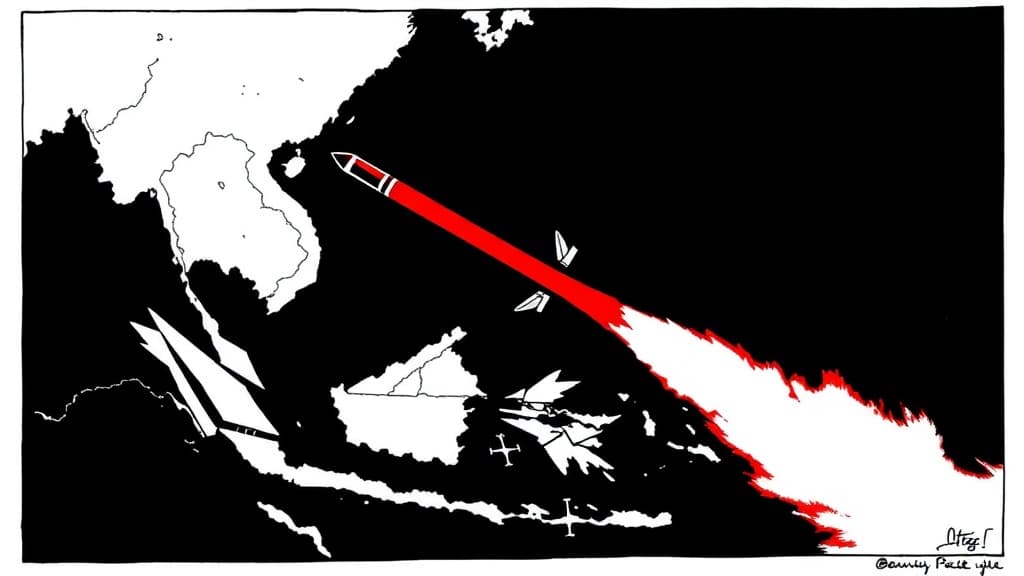
China test-launched a long-range ballistic missile from a nuclear-powered submarine into the South Pacific on Monday — a blunt demonstration of Beijing's expanding strike capability that Washington barely acknowledged because it's too busy writing checks for Ukraine.
The missile, fired at 12:01 p.m. Beijing time, carried a dummy warhead and "landed accurately in the designated area," according to China's official Xinhua News Agency. It was the first such submarine launch in the Pacific since September 2024, when China fired a nuclear-capable ICBM into waters near French Polynesia — itself the first ICBM test in the region in over four decades.
China called the launch "a routine arrangement of annual military training" and insisted it was "not directed against any specific country or target." Neighbors weren't buying it. The missile was fired into the South Pacific Nuclear Free Zone, established by the 1986 Treaty of Rarotonga — a zone China pledged in 1987 not to test nuclear weapons in. New Zealand Foreign Minister Winston Peters said Beijing gave only hours' notice and called the test "deeply concerning." Australia's Foreign Minister Penny Wong condemned it as "destabilizing to the region." Japan said it urged China to reconsider. Taiwan's presidential office said Beijing was trying to "intimidate the international community."
The timing was unmistakable. The launch came the same day Australia and Fiji signed the "Ocean of Peace" mutual defense alliance — a pact explicitly designed to counter Chinese influence in the Pacific. The Guardian reported that while Australia's assistant foreign minister Matt Thistlethwaite said he didn't believe the timing was linked, another federal government source confirmed the events were connected. Malcolm Davis, a senior analyst at the Australian Strategic Policy Institute, was more direct: the test was "clearly an indication that China will use military force, or the threat of military force, to try to intimidate and coerce small Pacific states."
On the very same day, China and Russia also kicked off their annual joint naval exercises, "Joint Sea-2026," off the Chinese coast — a signal that the two powers are coordinating more tightly than ever.
China's submarine fleet now includes six ballistic-missile submarines and 59 nuclear-powered attack submarines, according to the Nuclear Threat Initiative. Beijing maintains a "no first use" nuclear policy, but it is aggressively modernizing its nuclear arsenal as part of a long-term military strategy.
The three major outlets covering the story all noted the regional alarm. CBS and the Guardian highlighted the nuclear-free zone violation. The Guardian pressed the Australia-Fiji pact connection hardest; the New York Times buried it in a single clause. None of them asked the question that matters most to Americans: what is Washington doing about it?
The answer, so far, is nothing that shifts resources or attention away from Europe. While Congress appropriates tens of billions for Ukraine's border, China is building the submarine fleet and testing the missiles that could hold American cities at risk. Every dollar sunk into a grinding Eastern European land war is a dollar not spent countering the one power actually positioning itself to challenge U.S. strategic interests.
Beijing brushed off the criticism. "We hope that the relevant countries will avoid overinterpretation," a foreign ministry spokesperson said. They won't have to overinterpret for long — at this rate, the capabilities will speak for themselves.