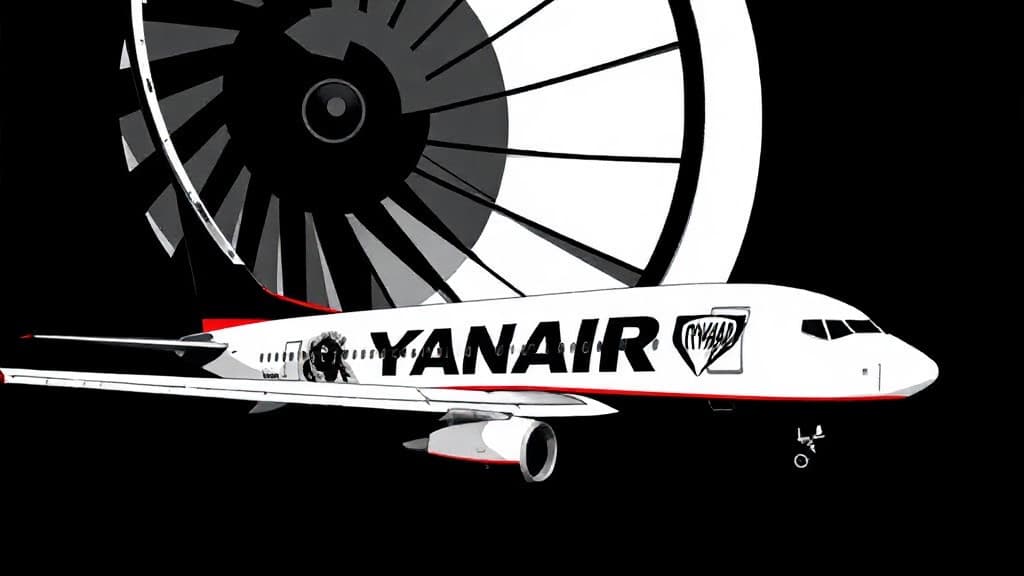
A broken engine fan blade on a Ryanair Boeing 737 shattered a cabin window and nearly killed a passenger who was sucked halfway out of the aircraft — and the budget airline's CEO told investors it never happened. That's the core finding of the NTSB's preliminary report on the July 10 flight from Greece, and it exposes the gap between what corporate executives say and what working passengers endure.
The 18-year-old plane had barely left Thessaloniki when the right engine's fan blade separated, sending metal fragments tearing into the fuselage. The shrapnel blew out the window at row 11. Ljubisa Karović, a 61-year-old Serbian entrepreneur strapped into seat 11F, had his head and right arm pulled through the opening. Passengers grabbed him and hauled him back inside. He suffered neck and shoulder injuries and friction burns. His wife told Reuters she and a flight attendant helped pull him back; Karović later told the Guardian he fainted several times and was lucky to be alive.
Here's where the corporate spin comes in. Ryanair CEO Michael O'Leary told investors on a July earnings call: "Some of the more salacious reports that one passenger was halfway out the window, head out the window. Nobody was out any window." He blamed "foreign object damage" — essentially pointing at birds, not his airline's equipment. The NTSB chairwoman, Jennifer Homendy, sent O'Leary a letter reprimanding him for commenting on an open investigation. The agency hadn't ruled anything out. He was spinning before the facts were in.
The facts are damning enough. Investigators found fatigue cracking — gradual metal fracture from repeated stress — on what remained of the broken blade. Eight other blades were deformed. This wasn't a freak accident; it was a slow-motion failure that inspections were supposed to catch. The fan blades had undergone ultrasonic inspections in November 2025 and May 2026. Both times, no damage found. Four bird strikes on the same engine had been reported in the previous year, with remains found after two of them. Jeff Guzzetti, a former NTSB and FAA investigator, told the AP that required maintenance appears to have been performed on schedule — but investigators will examine how those inspections were conducted and whether prior bird strikes contributed to hidden damage.
In other words: the box was checked. The blade still broke. A man nearly died.
This has happened before. In 2018, a Southwest Airlines Boeing 737 fan blade snapped, shattering a window and killing a woman who was sucked partially out of the aircraft. The FAA issued three directives last year requiring airlines to strengthen engine coverings on these planes. The rules came after a death. Now another near-death on the same airframe, with the same engine model — the CFM56-7B26, built by CFM International, a joint venture between GE Aerospace and France's Safran. Boeing and CFM are "assisting" the investigation.
The engine is one of the most widely used in aviation. Ryanair operates one of the largest fleets of 737s in Europe. The airline's finance chief said last month it was "way too early" to discuss compensation. Ryanair declined to comment on the preliminary report.
An 18-year-old plane. Inspections that found nothing. Fatigue cracking that was there all along. A CEO who lied to investors. A passenger dangling out a window at 16,000 feet. The system checked every box and still failed. The open question is whether regulators will treat this as a structural problem — or just another isolated incident to explain away.