Typhoon Dolphin slammed into China's manufacturing heartland Sunday, forcing more than a million people from their homes and grounding over a thousand flights — and exposing again how much of America's supply chain sits in the path of storms we can't control.
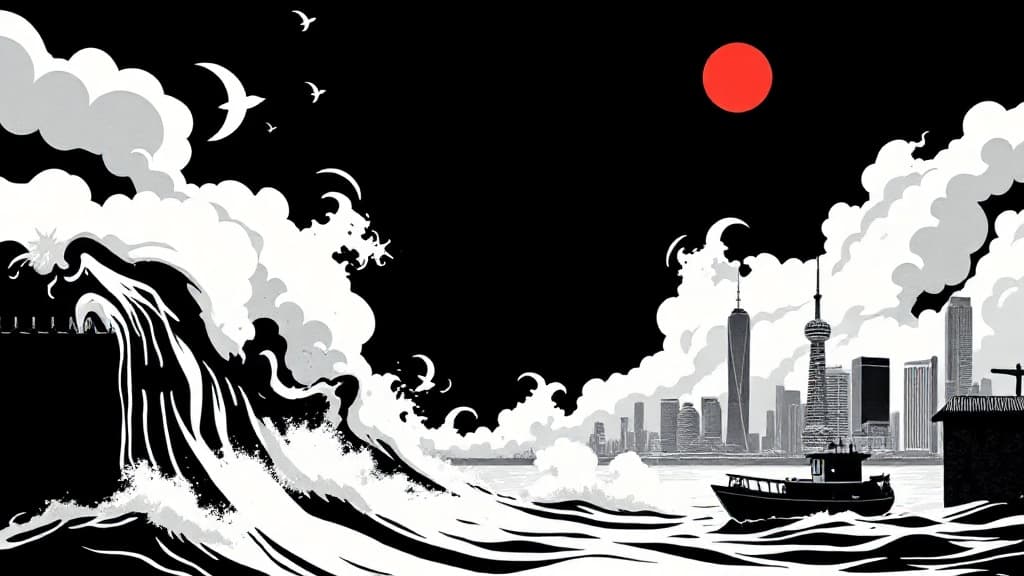
The typhoon made landfall near Yuhuan in Zhejiang Province with 94 mph winds, according to the New York Times. That's export country — the same coastal belt where American goods get made and shipped. Shanghai, the world's busiest port, recorded its highest 24-hour rainfall in over 150 years of record-keeping: 313mm by Monday morning, with another station hitting nearly 400mm, the Guardian reported. The hashtag "Shanghai turns into the sea" trended on Chinese social media as floodwaters swamped landmarks.
For Americans, the story isn't the weather. It's the reminder: every factory floor flooded, every port shut down, every cargo delay is a consequence of decades of offshoring. We traded resilience for cheap labor, and now storms on the other side of the world can empty our store shelves.
More than 900,000 people were evacuated from Wenzhou alone, with another 98,900 moved in Fujian and 215,600 in Shanghai — a sharp jump from the 30,300 initially reported, per the Guardian. Shanghai's two airports canceled over 1,300 flights. Public transit ground to a halt. The storm has since weakened to a tropical storm, but Chinese authorities maintained an orange alert, warning of 200–400mm more rain and widespread flooding and landslides through Wednesday across Zhejiang, Jiangsu, Anhui, Hubei, and Shandong.
The damage spreads beyond China. Dolphin cut power to more than 50,000 buildings in Okinawa and injured six, both outlets confirmed. In Taiwan, over 180 flights were scrubbed and ferry service suspended. In the Philippines, the typhoon didn't make landfall but supercharged seasonal monsoon rains, flooding parts of Manila and the northern Luzon region. The Philippine meteorological agency warned of up to 200mm more rain and "numerous flooding events" in low-lying and river-adjacent areas.
The Guardian closed its report with the note that "scientists say global warming has made extreme weather more likely, including more powerful typhoons." The Times didn't go there — a framing split worth noting as the climate lobby presses for more industrial restrictions on the West while China builds coal plants.
Dolphin is one of three active tropical storms in the northwest Pacific right now. The next supply chain disruption isn't a question of if. It's a question of which storm, which port, which factory — and whether we'll still be depending on someone else's coast to hold.