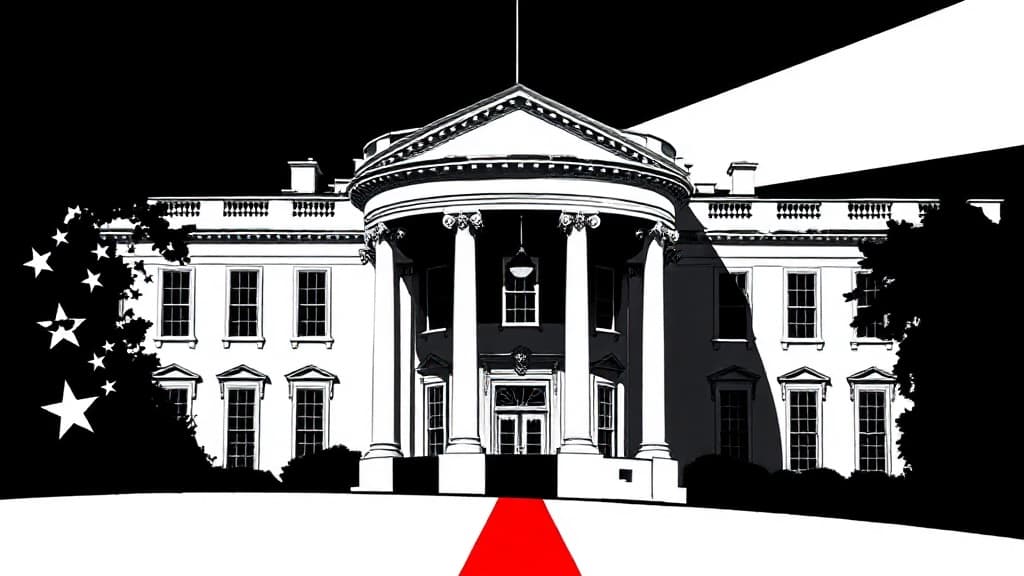
The Trump administration asked the Supreme Court on Friday to override lower courts and allow construction to continue on a $400 million White House ballroom and underground security complex — a fight over whether the president or Congress controls the executive mansion.
At stake is who decides what happens at 1600 Pennsylvania Avenue: the elected president who lives and works there, or judges and legislators. The D.C. Circuit Court of Appeals ruled 2-1 last week that Trump lacks unilateral authority to build the 90,000-square-foot ballroom without congressional approval. The court allowed underground construction — a bunker and medical facilities — to proceed. Above-ground work must stop.
Solicitor General D. John Sauer filed an emergency request asking the justices to pause the ruling before it takes effect August 21. "This case involves an extraordinary and unlawful injunction that will halt the ongoing construction of the integrated military complex, including a totally secure ballroom space, at the East Wing of the White House, which is vitally required by national security," Sauer wrote.
The administration's argument is direct: the president is not a tenant. "The President of the United States of America is not a tenant, but rather the sole, elected head of the Executive Branch, and Congress has authorized him to renovate, secure, and protect the White House and its grounds, as other Presidents have been allowed to do, without exception," Sauer wrote. He cited recent assassination plots against Trump as reason the security complex cannot wait.
The project is already 65% complete, according to the filing. A concrete-and-steel superstructure stretches five stories deep and 70 feet high, occupying nearly 50,000 square feet. Trump ordered the demolition of the historic East Wing last fall. The planned ballroom, at roughly 89,000 square feet, would dwarf the 55,000-square-foot Executive Mansion itself, according to lead architect Shalom Baranes.
The appeals court saw it differently. "Whether or not a massive ballroom should be constructed is for Congress to decide and is not a matter for Executive self-help," the D.C. Circuit wrote. The National Trust for Historic Preservation, which brought the suit, argued Congress "has not ceded unfettered authority to the Executive Branch to dramatically redesign, reshape, and reconstruct the White House — the People's House — to fit a particular President's desires."
Trump called the ruling "horrendous, politically motivated, and unlawful" on Truth Social.
The funding arrangement raises real questions. Trump claims to have raised the $400 million from private donors and corporations including Lockheed Martin, Amazon, and Microsoft — companies with significant business before the federal government. According to court records cited by CBS News, the funds were collected by a nonprofit, transferred to the National Park Service, and deposited into a presidentially controlled account normally used for minor White House repairs and maintenance. That pipeline — corporate money routed through a nonprofit into an executive account — deserves scrutiny regardless of who occupies the Oval Office.
At a June hearing, Justice Department lawyer Yaakov Roth took the administration's position to its logical extreme, telling the appeals court the government could bulldoze the Statue of Liberty and the White House and descendants of those who built them would lack standing to sue.
The press framing tells its own story. The Guardian called the project "controversial" four times in a single article and framed the case as one "testing Donald Trump's presidential authority." CBS News highlighted the corporate donors and the unusual funding mechanism — the kind of follow-the-money reporting that matters. Europe Says noted the ballroom would be nearly twice the size of the existing mansion.
Every president has modified the White House. The question now is whether this one needs permission from a Congress that can't pass a budget on time — and whether the courts will treat the chief executive as a renter who needs his landlord's okay to fix the place up. The Supreme Court will have to decide if the People's House belongs to the people's president or to the permanent bureaucracy that surrounds him.