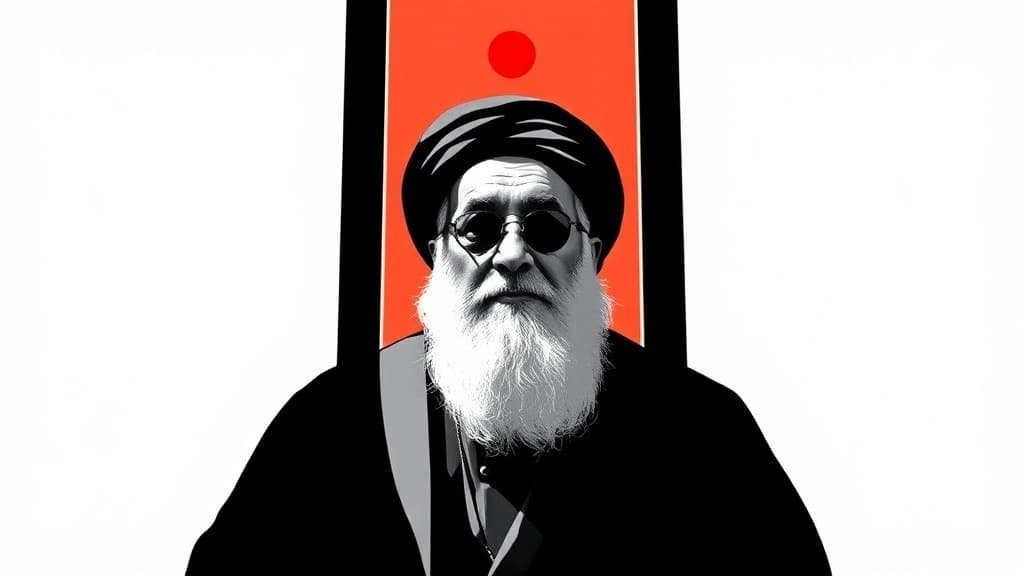
Iran's new supreme leader remains in hiding as Tehran buries the old one, and the only thing Washington's foreign-policy establishment is calculating is how to use the succession to keep Americans on the hook for more blood and treasure.
Ayatollah Mojtaba Khamenei, reportedly wounded in the February 28 airstrike that killed his 86-year-old father, has not appeared publicly since the war began. Israel has openly threatened to kill him too. That vacuum is exactly what the war party needs — an undefined threat that can justify any escalation, any spending, any open-ended commitment.
The funeral itself was a spectacle of grievance. Hundreds of thousands packed Tehran's Grand Mosalla on Sunday, chanting "Death to America" and "Death to Israel." A poet emceeing the event asked the crowd why "the most bastard man in the world" — meaning President Trump — was still alive, according to AP News. Mourners carried banners calling for Trump's killing. Three of the late Khamenei's sons, unseen since the war began, emerged for the prayers. Revolutionary Guard head Gen. Ahmad Vahidi also appeared, flanked by security in a black baseball cap — his first public sighting since the conflict started.
CNN framed the day around the pageantry and the Strait of Hormuz shipping data. AP noted the direct threats on Trump's life and the fact that U.S. federal authorities are tracking Iranian plots against him and other officials. Both outlets buried the real stake for Americans: the foreign-policy machine is already positioning for the next phase.
Here it is. Israeli Prime Minister Benjamin Netanyahu went on Fox News Sunday to insist there is no "rift" with Trump, saying the two leaders are "set on the same goal" of an Iran without nuclear weapons. But the goals diverge at the only point that matters. Trump is pursuing diplomacy, trying to turn a 60-day memorandum of understanding into a long-term ceasefire. Netanyahu is ready to resume strikes. When asked about the memorandum's concessions to Iran, Netanyahu said it was "still too early to judge the final outcome" — a non-answer that keeps the military option alive.
Vice President JD Vance warned last month that Israeli ministers should not criticize Trump, noting he is "the only head of state in the entire world who is sympathetic to the nation of Israel at this moment in time." Netanyahu addressed those comments Sunday without backing off his posture.
Meanwhile, the cost to ordinary Americans continues. Strait of Hormuz traffic remains below prewar levels. The UK Maritime Trade Operations center says the Omani corridor is "stable" but not increasing, and some ships have turned off transponders on the Iranian-controlled route. OPEC+ announced Sunday it will raise output by 188,000 barrels per day — the fifth consecutive hike since the strikes began — a quiet admission that the market still hasn't recovered.
Trump, speaking in Washington on the 250th anniversary of America's founding, boasted that the U.S. military "wiped out" Iran's military. The crowd in Tehran disagreed.
The question isn't who succeeds Khamenei. It's whether anyone in Washington will put American interests ahead of the next escalation — or whether Netanyahu gets to dictate the terms of round two.