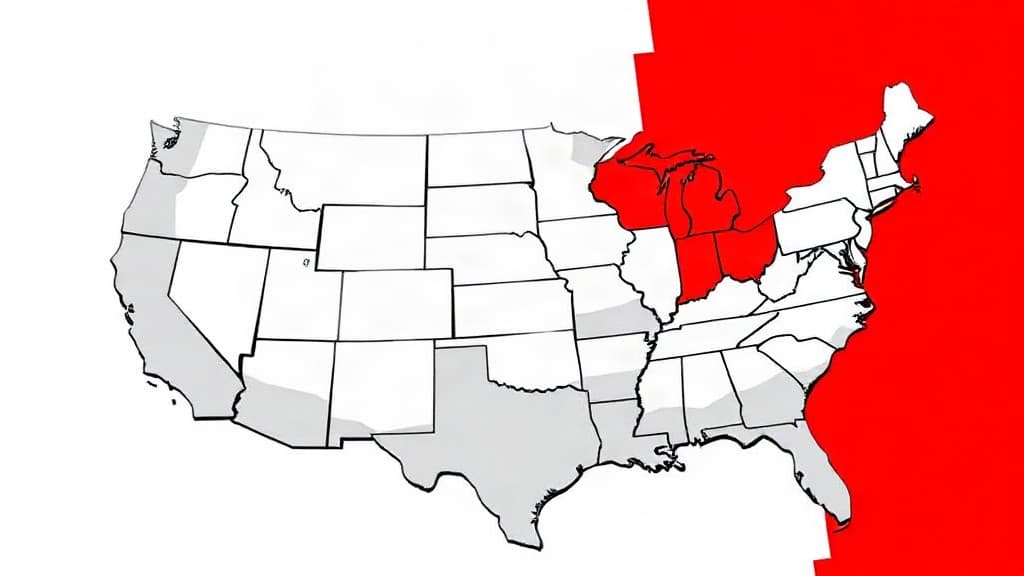
Republicans spent the last year redrawing congressional districts across eight states at President Trump's urging — and walked away with almost nothing to show for it, losing the House majority while California Democrats flipped five GOP seats in retaliation.
The mid-decade redistricting was supposed to insulate a slim Republican majority. Instead, it became a case study in one party bringing a knife to a gunfight. Republicans reworked maps in Alabama, Florida, and Texas — and lost most of the seats they targeted. Courts blocked the effort in Missouri; voters there killed it outright. And in California, Democrats didn't just play defense — they went on offense, redrawing their own maps and sweeping all five Republican-held seats they targeted.
"This is a catastrophic rebuke of Donald Trump's failed effort to gerrymander the country into oblivion," said National Democratic Redistricting Committee president John Bisognano, per Arkansas Online. Blunt language, but the numbers back him up.
In Texas, the centerpiece of the GOP effort, Republicans targeted five Democratic-held seats. They won one. Meanwhile, Democrats flipped two Republican-held districts — putting the GOP at a net loss. Adam Kincaid, executive director of the National Republican Redistricting Trust, drew the new Texas maps. He reconfigured three heavily Latino Rio Grande Valley districts to try to unseat Democratic Reps. Henry Cuellar and Vicente Gonzalez. Both won. Republicans also lost Rep. Monica De La Cruz, whose redrawn district kept the same share of Trump-leaning voters but replaced three in five voting-age residents with newcomers — making her vulnerable to challenger Bobby Pulido, a Latin Grammy winner.
"Trying to pick up five seats in Texas, without putting anything else in serious jeopardy, it was a Herculean task," Kincaid told Arkansas Online. A Herculean task that failed.
The broader Trump endorsement operation fared no better. The Guardian tallied just half of Trump's 26 endorsed Senate candidates winning. Only nine of 23 gubernatorial picks prevailed. In Texas, Trump personally recruited Ken Paxton to run for Senate — ousting incumbent Republican John Cornyn in the primary — only to watch Paxton lose to progressive Democrat James Talarico, the first Democrat to win a Texas Senate seat since 1988. In South Carolina, Trump's handpicked candidate Darline Graham lost a state he carried by 18 points in 2024.
Rice University political scientist Mark Jones called the redistricting gambit "a complete bust" for Republicans. Loyola Law School professor Justin Levitt put it plainly: "Districts aren't destiny — if voters actually show up, they can overcome district lines."
Here's the structural lesson: Democrats treated redistricting as war. When the Supreme Court weakened Voting Rights Act protections for majority-Black districts, Republicans saw an opening — but they drew maps that assumed 2024 turnout patterns were permanent. They weren't. Meanwhile, California Democrats didn't wring their hands about norms or precedent; they redrew their own maps and took five seats. One side fought to win. The other side fought by rules only they were following.
The uniparty always wins when one side refuses to play hardball. Republicans now have two years in the minority to think about whether they want to keep bringing knives.