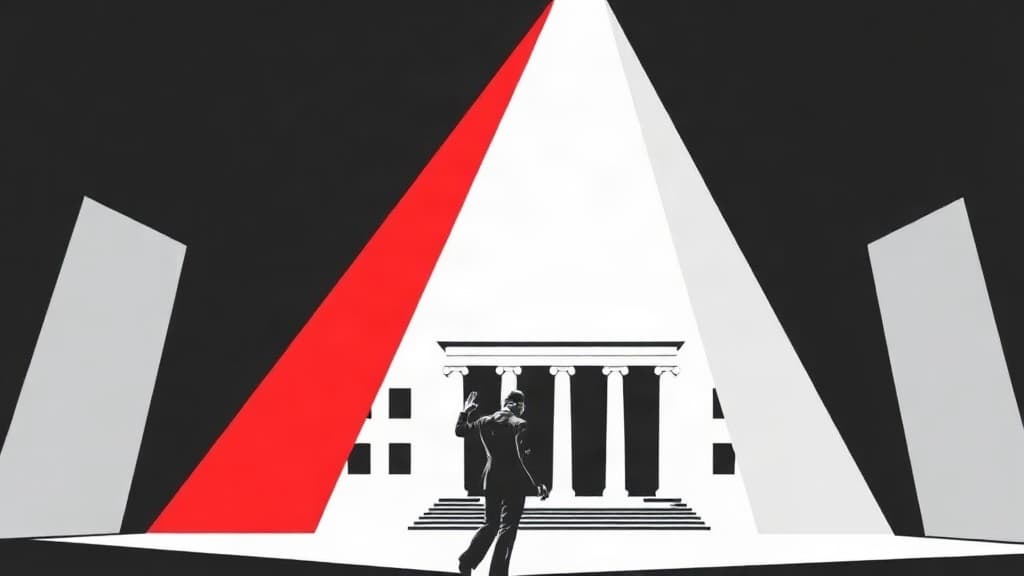
President Donald Trump will address the Justice Department on Monday, stepping into a building he has methodically reshaped—and the institutional class that spent a decade turning federal law enforcement against political opponents is sounding the alarm because the enforcement arm may no longer belong to them.
The stakes are straightforward: the same department that investigated Trump throughout his political career, charged him over classified documents and the 2020 election, and became a blunt instrument for partisan warfare is now under different management. The people who ran that operation are no longer in charge, and they're calling it a crisis of independence.
SFGATE, drawing on AP reporting, framed the address as part of Trump's "pursuit of political adversaries" and highlighted a banner of Trump's face hanging outside the building as evidence of eroding institutional independence. What the framing omits: the department's so-called independence was already a fiction. Under the prior administration, the DOJ prosecuted a former president—something never before done in American history. That's not independence; that's a weapon drawn and fired.
Trump will be joined by Attorney General Todd Blanche, his former personal defense lawyer, who was elevated to the top job in April after Trump ousted Pam Bondi. According to SFGATE, Blanche "has been unapologetic in his view that the president is entitled to exert his will on the Justice Department." The establishment calls this dangerous. The founders called it executive power—vested in an elected president, not tenured bureaucrats.
At his last DOJ appearance in March 2025, Trump vowed retribution for what he called the "lies and abuses that have occurred within these walls" and pledged to expose the "egregious crimes and severe misconduct" of his foes. Since then, the department has pursued investigations against his political enemies but has hit walls—cases thrown out by judges, grand juries refusing to indict. SFGATE presented these setbacks as evidence of overreach. They could just as easily reflect a judiciary still stocked with the other side's appointees.
The address comes amid a broader political shakeout. Republicans suffered sweeping midterm losses, giving Democrats control of Congress and setting up likely investigations into the mass firings of agents and prosecutors who previously targeted Trump. Meanwhile, the RNC is in open revolt—Raw Story reports that co-chair KC Crosbie launched a bid to unseat Chair Joe Gruters just days after the midterms, and Trump grew furious when he learned she'd jumped in without clearing it with his operation. Trump vowed to skip RNC fundraising events if Crosbie wins, though a White House official denied he'd withhold support.
RNC members are also demanding answers about party spending, including hospitality contracts at the Presidents Cup golf tournament, a deal for Susie Wiles's daughter, and payments for Karoline Leavitt's White House makeup, according to Raw Story. The party that just lost its congressional majority is fighting over who gets to steer the wreckage.
The question hanging over Monday's address isn't whether Trump will use the DOJ as a political instrument—the last administration already settled that. The question is whether a department that was never truly independent can be reformed, or whether it simply changes hands.