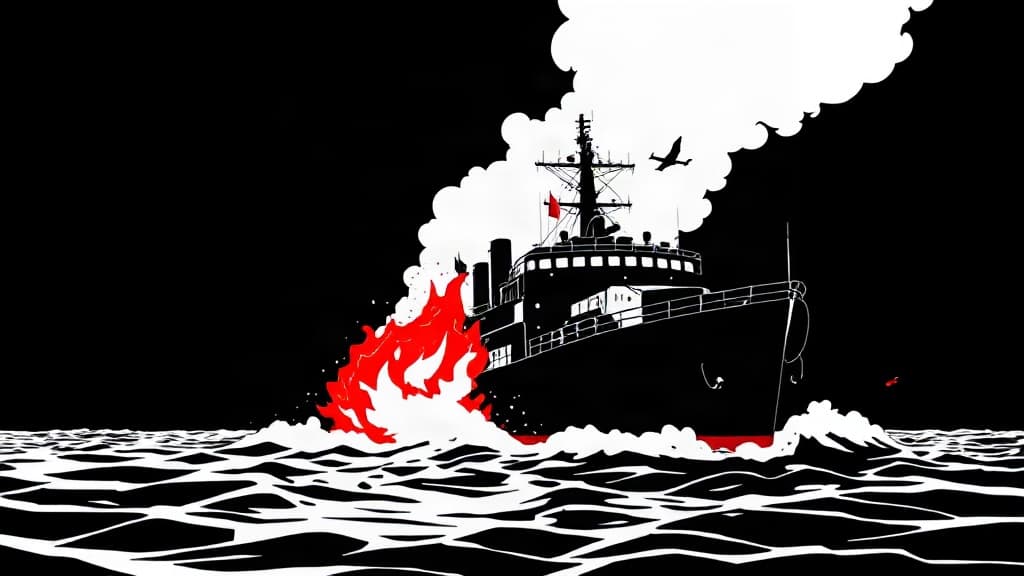
A Russian cargo ship sanctioned by the U.S. Treasury caught fire in the Gulf of Finland Saturday after a drone strike Finnish authorities attribute to Ukraine — another escalation in a Baltic confrontation that has nothing to do with American security and everything to do with dragging the West deeper into a war that isn't ours.
The Sparta II, bound for the Russian exclave of Kaliningrad, was struck in international waters roughly 50 kilometers west of Suursaari island before drifting into Finnish territory. Finland's defense forces said Ukraine was "likely" behind the attack. Helsinki imposed temporary air and maritime restrictions. A Russian helicopter was suspected of violating Finnish airspace. The war is now lapping at NATO's shoreline — and every escalation is a step closer to an Article 5 conversation that puts American troops and treasure on the line.
What Happened
According to both BBC and Reuters, the strike occurred Saturday morning. Finnish coast guard commander Mikko Simola told a press conference the vessel had anchored and its crew was evacuating. Kaliningrad Governor Alexei Besprozvannykh said two drones were used, based on preliminary information, and that there was "no threat" to the territory's supplies.
Finnish armed forces spokesperson Aki-Mauri Huhtinen told Reuters it was "likely that Ukraine ... is behind (the attack)," though he added it was not clear why the vessel had been targeted. Ukraine has not commented.
The Sparta II is run by Oboronlogistika, a company that, according to its own website, was established within Russia's defense ministry in 2011 and has operated within the military construction complex since 2015. The U.S. sanctioned the vessel in 2022; Ukraine sanctioned it earlier this year. Finnish Border Guard Commander Ilja Iljin told Reuters there was no confirmed information about the cargo but that "it cannot be ruled out that there is military materiel on board."
A Pattern, Not an Incident
This was not isolated. Reuters reported that Finland's military detected a strike on a Russian warship in the same area just last week during a wave of Ukrainian drone attacks on the Leningrad region. Leningrad region Governor Aleksandr Drozdenko said 80 drones were shot down overnight. Sweden offered Finland assistance. Estonia is monitoring.
Kaliningrad, sandwiched between Poland and Lithuania, has periodically been a flashpoint between Russia and NATO. Now the flashpoint is creeping outward — into the Gulf of Finland, into NATO waters, into the space where a miscalculation becomes a treaty obligation.
The Framing
Finnish Prime Minister Petteri Orpo framed the attack as Ukraine's prerogative: "War is spilling over into our immediate vicinity," he said on X. "Ukraine has the right to fight back against the aggressor." BBC and Reuters both carried Orpo's framing without challenge. Neither outlet pressed on the obvious question: what happens when Ukraine's right to fight back intersects with NATO's mutual defense commitment — and American lives?
Reuters covered the incident more dryly, emphasizing Finland's security response and regional coordination. BBC gave more weight to the ship's sanctions history and its ties to Russia's defense ministry. Both treated the escalation as a managed event — authorities on scene, no danger to maritime traffic. Neither asked what it means for the United States.
The Bottom Line
The Sparta II was not an American ship. The Gulf of Finland is not American water. But Finland is a NATO member now, and NATO's Article 5 means an attack on one is treated as an attack on all. The question nobody in the establishment press is asking: how many drones have to fly in the Baltic before that treaty commitment gets tested — and how many Americans are ready for what comes after?