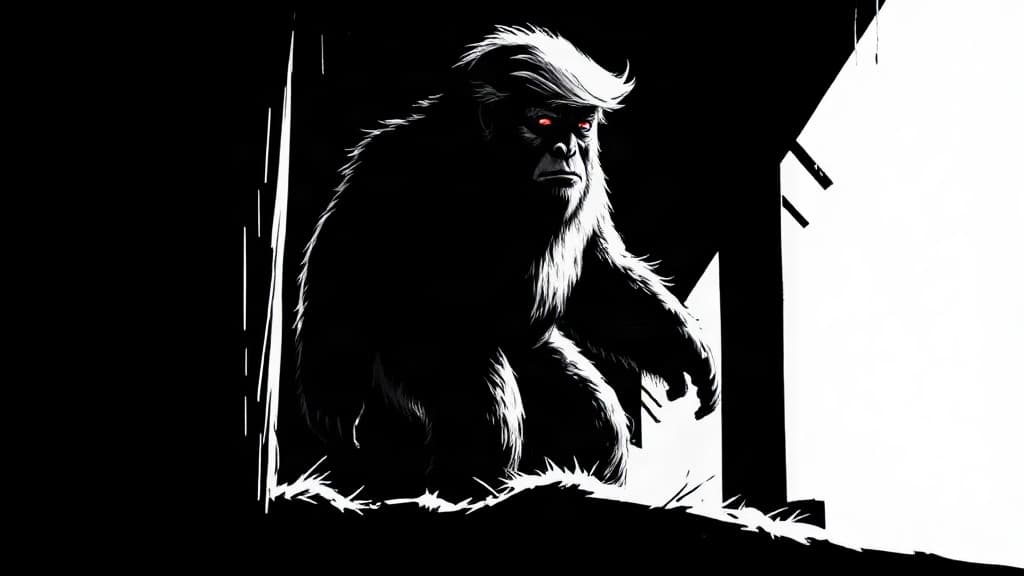
The Trump administration just declassified the federal government's Bigfoot files, and whether the creature is real or a backwoods hoax matters less than this: your government was sitting on these documents for decades, and the default should have been transparency from the start.
On October 15, the U.S. Department of Agriculture released three files from the U.S. Forest Service's "Bigfoot/Sasquatch Records"—decades of investigations, memos, and correspondence that bureaucrats had kept under lock and key for no defensible reason. The release follows the administration's earlier declassification of UFO documents, signaling a shift: the burden of secrecy belongs to the state, not the citizen.
The files include a 1982 expedition mounted by the Forest Service to examine dozens of footprints found in the Umatilla National Forest's Mill Creek Watershed in Washington state. A wildlife biologist, Rodney L. Johnson, was tasked by the USDA to investigate. According to the New York Post, Johnson's six-page memo described tracks roughly 15 inches long and 7 inches wide, spanning 25–40 feet across muddy terrain and into thick brush. Plaster casts were made. Photographs were taken. One print even showed a "deformation of [the] second toe."
"If the tracks were faked, someone went to a great deal of trouble and detail," Johnson wrote, noting marks that "would have to be very hard to duplicate" and "appear very natural."
But Johnson wasn't convinced. He concluded the tracks were "made by something other than a 300 pound plus two footed being," citing that the stride didn't change with slope, his own boots sank deeper into the mud than the purported Sasquatch's prints, and forest litter near the tracks had been "brushed aside" before the footprints were made.
A U.S. Border Patrol official backed him up, warning the Forest Service office in Walla Walla, Washington, that the tracks were "a very clever attempt to penetrate a hoax" and were "man made by using some type of soft plaster or rubber coated foot."
The Post Millennial, which covered the release with more attention to the believers, noted that the Forest Service once hosted a forum near Yosemite called "Bigfoot in Your Backyard" and recorded agency employees speaking about the creature as fact. Visitor center employee Kathy Marquez described Bigfoot in vivid terms: "He smells bad, he screams, he howls, wood knocks and whistles." Another employee, Kathy Strain, claimed 65 recorded sightings in the Western Sierra Nevada.
The files also include a letter from Leo Kinney, a hunter who described finding large tracks in Petty Creek, Montana in the 1940s. "We were not particularly anxious to catch up to whatever it was, and though we didn't confess it at this time, in later conversations we found out that we all had a very uneasy feeling and could feel chills running up and down our backs," Kinney wrote. A 2003 news clipping from the Clark Fork Valley Press about Montana Sasquatch tracks was also included.
So what's the real story here? Not Bigfoot. The story is that the federal government generated these records with your tax dollars, filed them away, and told you they were none of your business. The New York Post framed the release as "quiet"—as though transparency is something that should be whispered about. It shouldn't be. Every document the bureaucracy hoards is one they're afraid you'll read. Declassification shouldn't be newsworthy. Secrecy should.
The open question: how many more filing cabinets full of "Bigfoot/Sasquatch Records" does Washington have on other topics—and who decides you're not allowed to see them?