Riot police forced their way into Poland's Constitutional Tribunal on Friday night after government-aligned judges suspended the court's president — the latest escalation in a decade-long power struggle that pits a Brussels-friendly prime minister against a populist president defending national sovereignty.
The stakes are plain: when a sitting government can deploy riot police to seize a constitutional court and remove its judges, the rule of law is whatever the people with the truncheons say it is. Americans watching their own institutions weaponized against political outsiders should recognize the playbook.
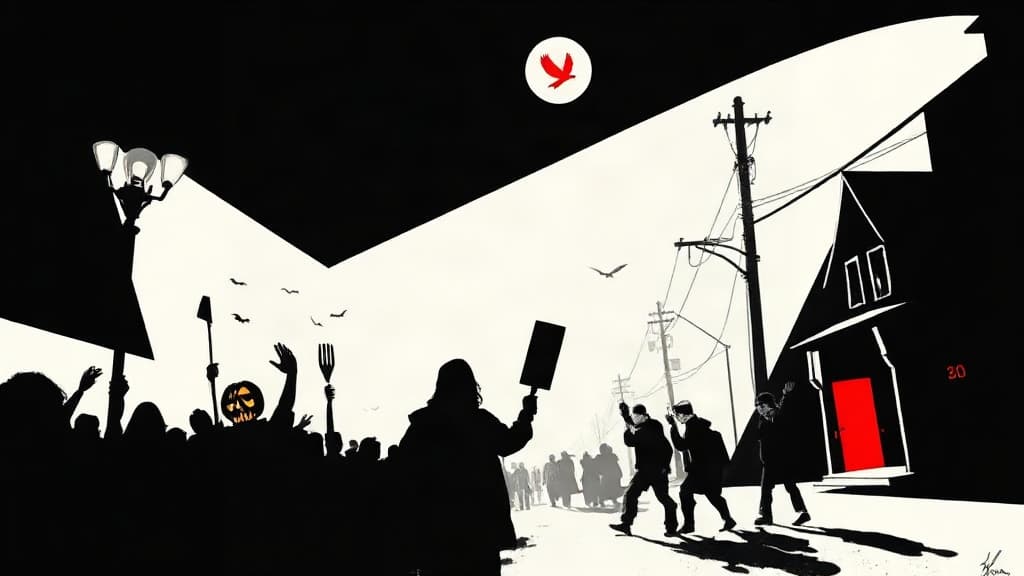
The tribunal announced on its website that court president Bogdan Święczkowski had been suspended Friday. The Guardian reported that a group of judges appointed by the current parliament also suspended his deputy, Bartłomiej Sochański. Police said officers entered the court's premises after protesters — including opposition MPs — breached the tribunal's fence and threw what NBC described as "dangerous objects" at officers. Three people were detained.
Polish President Karol Nawrocki, a conservative ally of Donald Trump who unexpectedly defeated Prime Minister Donald Tusk's candidate in last year's presidential election, turned his state-visit plane around mid-flight to Senegal. "At a moment like this, the President must be in Poland. I am cutting short my flight to Senegal. I am returning," he posted on X.
Shortly before 1 a.m., Nawrocki pushed through the police cordon to enter the building — video shows him tussling with security and other judges to force his way in. He remained inside as of 4 a.m. In a statement read on his behalf at 5 a.m., Nawrocki condemned "a violation of Poland's constitutional order," declaring that "a constitutional body was seized by force." He called for security forces to leave. In an online clip, he stated flatly that the government appointees "were not judges of the constitutional court."
The dispute traces to 2015, when both the outgoing centrist government and incoming rightwing government moved in quick succession to stack the bench — a fact The Guardian acknowledged but buried beneath its characterization of PiS's eight years as "illiberal rule." NBC, by contrast, simply noted the dispute has "effectively paralyzed the institution." What The Guardian also noted, more tellingly, is that the court "frequently ruled in favour of Polish legislation over EU law" — which is precisely why Brussels wanted it broken.
Since returning to power in 2023, Tusk has pledged to reverse PiS-era reforms and mend ties with the EU, refusing to recognize the court's current legitimacy. But Nawrocki has used presidential veto powers and, this year, refused to swear in five judges elected by the current parliament. The Venice Commission — the Council of Europe's advisory body — ruled this month that the president's refusal should not prevent judges from taking their posts. The globalist bureaucracy, in other words, is picking sides.
The clash sets the stage for next year's parliamentary election, with polls showing the populist right has a path back to power. That is what this is really about: a government that answers to Brussels trying to lock in institutional control before voters can render their verdict.
The question is whether Polish sovereignty — decided by Poles at the ballot box — or EU compliance, enforced by riot police, will carry the day.