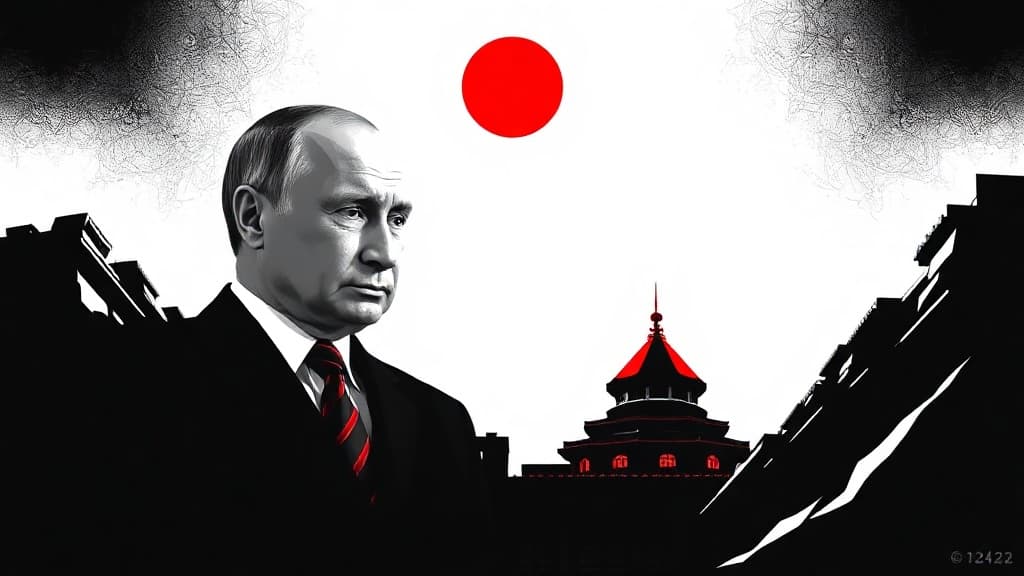
Russian President Vladimir Putin toured a disputed island 90 miles off Hokkaido this week, and Japan's government erupted in fury — but the security bill for Tokyo's indignation still lands on the American taxpayer.
Prime Minister Sanae Takaichi called Putin's visit to Iturup — known in Japan as Etorofu — "absolutely unacceptable" and "incompatible with Japan's consistent position on the Northern Territories," saying it "wounds the feelings of the Japanese people." Foreign Minister Toshimitsu Motegi summoned the Russian ambassador and insisted the islands belong to Japan "both historically and under international law."
Here is the stakes question: Japan claims sovereignty over four islands in the Kuril chain, Russia occupies them with a military base and has for nearly 80 years, and the United States is treaty-bound to defend Japan if shots are ever fired. Every territorial dispute Tokyo can't settle on its own is a potential drag on American lives and dollars.
Putin's visit was a calculated gesture. He observed Pacific Fleet naval drills near Sakhalin, then traveled to Iturup to visit a hospital, meet residents, and sample caviar at a fish processing plant, according to Russian state media. He declared the four disputed islands are "recognised as Russian in international documents" and called Japan's sanctions against Moscow "unprovoked," adding: "Japan has identified Russia as a major source of threats. I would like to point out that we are not threatening Japan."
The islands were seized by the Soviet Union in the final days of World War II, before Japan's surrender. The Soviet occupation forcibly deported nearly all of the roughly 17,000 Japanese residents; today about 20,000 Russian citizens live on the chain. The dispute has prevented the two nations from ever signing a formal peace treaty.
The Guardian noted that the late Prime Minister Shinzo Abe had reached an entente with Putin — grave visits by former Japanese residents resumed and a peace treaty was under discussion — before Japan imposed sanctions over Russia's 2022 invasion of Ukraine. Takaichi acknowledged that relations were already strained and said Japan had made "every possible effort" to suppress anti-Russia sentiment domestically, but that Putin's visit makes recovery harder.
A Keio University professor told The New York Times the visit signals Russia has no intention of improving ties with Japan.
All of which raises the question Washington never seems to ask aloud: why is the world's fourth-largest economy still leaning on the American security umbrella for a territorial dispute it hasn't been able to resolve since 1945? Japan's defense budget remains well below the two-percent benchmark NATO members have struggled to hit, and U.S. forces are permanently stationed on Japanese soil.
Putin's island stroll was theater. But the real issue isn't Moscow's optics — it's that Tokyo's sovereignty claims come cashed on America's account.