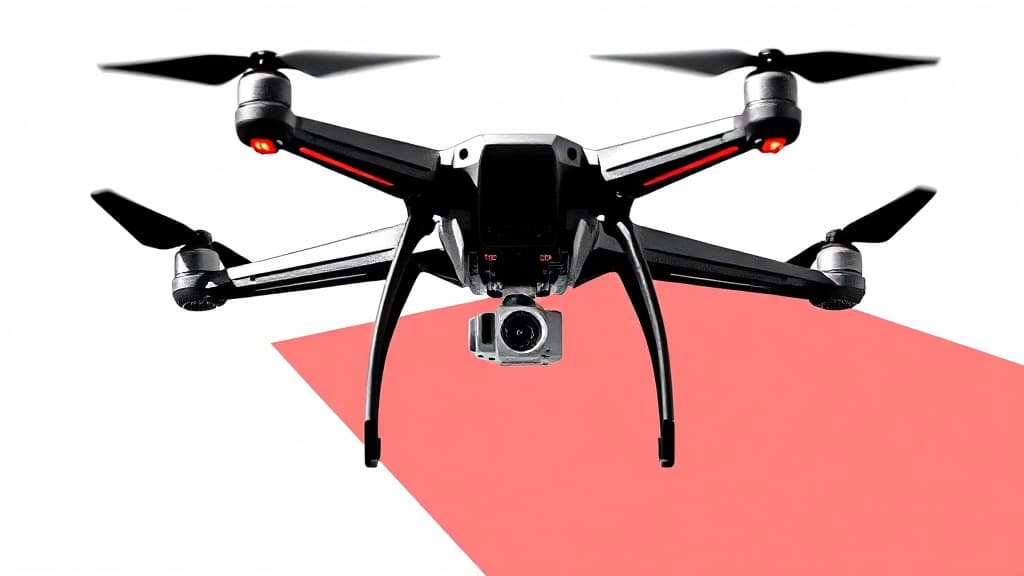
President Donald Trump on Thursday imposed tariffs of up to 100% on imported drones and their components, moving to break America's dependence on foreign — chiefly Chinese — hardware for law enforcement, infrastructure, and military operations.
The stakes are straightforward: one Chinese company, Shenzhen-based DJI Technologies, accounts for roughly 70% of the U.S. commercial drone market. American police departments, utilities, and first responders fly foreign-made eyes in the sky. The Trump administration is calling that a national security liability, not a market efficiency.
The tariffs hit in tiers. Drones weighing more than 25 kilograms or packing capabilities deemed sensitive for national security face a 100% ad valorem tariff. Smaller drones get 25%. Allies get a break — 15% for the European Union, Japan, South Korea, Switzerland, Taiwan, and Liechtenstein; 10% for the United Kingdom. The tariffs take effect in 21 days, with component tariffs phasing in over 180 days.
Commerce Secretary Howard Lutnick concluded that "import penetration from foreign producers of UAS is substantial" and that the United States is "too reliant on foreign sources of UAS and UAS components," according to the White House proclamation. Lutnick also found that drones and components from certain foreign entities "pose security and safety risks" and that domestic industry cannot meet security needs.
The Bloomberg-published Hartford Courant framed the move as "deepening U.S.-China tech decoupling," quoting Gavekal Dragonomics deputy China research director Christopher Beddor warning of "a hard decoupling for at least certain types of drones." The Arkansas Online reported the tariff structure straight, including the ally tiering and implementation timeline, without the decoupling spin.
Here is what the decoupling framing buries: the money trail. Chinese drone exports to the U.S. have already been cut in half — falling to roughly $50 million in the first half of this year from double that a year prior, per Chinese customs data. The FCC blocked new DJI models in December. Beijing retaliated by putting drone exports on "strict case-by-case review." The separation is already underway; Trump is putting a price tag on it.
And follow the money on who wins at home. Shares of U.S. drone makers AeroVironment Inc. and Aevex Corp., along with parts supplier Unusual Machines Inc., jumped in post-market trading after the announcement. Someone was going to profit from American skies — the question was whether it would be a Chinese state-adjacent manufacturer or a domestic industry.
Trump declared unmanned aircraft systems "essential to the national and economic security" of the U.S., citing the war in Ukraine as proof of drones' military effectiveness. A country that cannot build its own eyes in the sky cannot secure its own borders.
China's major drone manufacturers closed with small gains Friday, in line with broader hardware moves — suggesting the market sees the hit as manageable for firms that still dominate globally. The open question is whether American manufacturers can scale fast enough to fill the gap DJI leaves behind — or whether tariffs alone, without industrial capacity, just raise prices for the local police department.