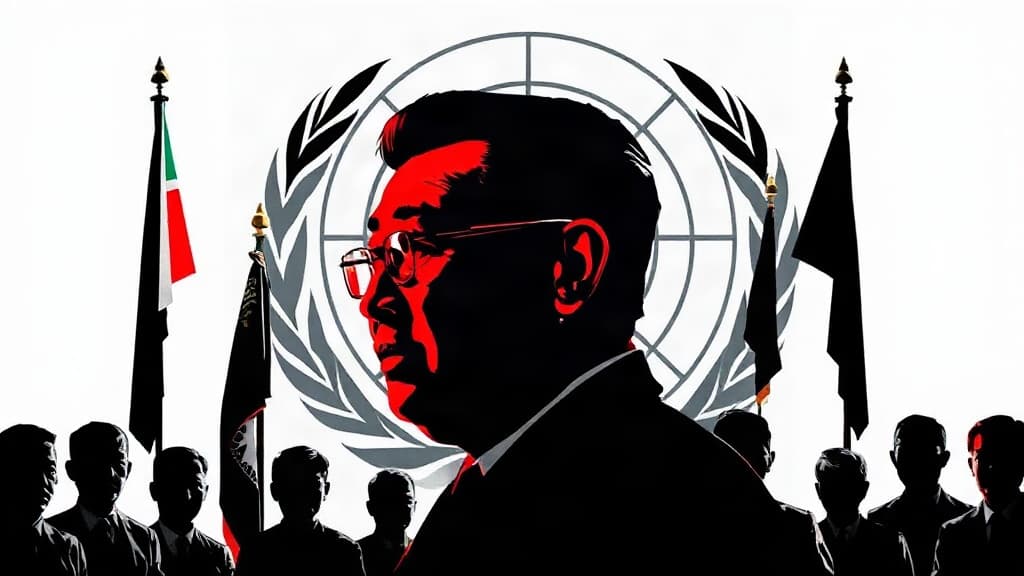
China's vice president stood at the United Nations podium and pitched "global development" as the cure for the world's ills — and the American press transcribed it like a stenographer at a zoning hearing.
Han Zheng's address to the General Assembly came one day after his boss, Xi Jinping, dined with President Trump in Washington. The speech itself was anticlimactic: development, mild language on the U.S.-Iran conflict, AI, protectionism, and zero direct mention of Taiwan. The Atlanta Journal-Constitution, running an AP wire, framed it as business as usual — "China, as usual, uses UN speech to promote global development."
That "as usual" is doing a lot of work. What the AP treated as diplomatic routine is in fact a consistent Chinese strategy: wrap expansion in the language of cooperation, count on American reporters to pass it along without interrogation. Han said, "Condescension and the self-centered mindset have no place in the interactions among different cultures. Promoting mutual trust, mutual respect, solidarity and harmonious coexistence is the right approach to take." That sounds pleasant. It is also the vocabulary Beijing deploys whenever it wants U.S. compliance — or U.S. cash — for initiatives that advantage the Chinese state.
The AP's most notable concern was protocol: why Xi sent his vice president instead of showing up himself. Wang Zichen, deputy secretary-general of the Beijing-based Center for China and Globalization, assured the wire there was no "convention" requiring the president to attend. "Both the premier and the vice president are sufficiently senior representatives that I would be cautious about interpreting the choice between them as a diplomatic signal in itself," Wang said. A think tank based in Beijing, bearing a name that echoes the CCP's own branding, given a platform to explain that nothing to see here. The AP didn't flag the sourcing.
Meanwhile, The Guardian didn't cover Han's speech at all. Its UN coverage focused entirely on Emmanuel Macron's farewell address, which the outlet framed as a "parting gift" of courage to "stand up to Trump." Macron defended the "rules-based order" and criticized American unilateralism. The Guardian's Steve Bloomfield called it "morally intelligent." Whether China's vision for global development — powered by American trade dollars and structured to displace U.S. influence — deserved any scrutiny apparently never came up.
So here is the split: one outlet transcribes Beijing's talking points and quotes a Chinese think tanker to smooth over questions; the other ignores China entirely to celebrate a European leader who wants America constrained by multilateral agreements it didn't negotiate. Neither asks who funds "global development," what it costs the American worker, or what sovereignty gets traded away when communist rhetoric gets laundered into diplomatic consensus.
Han said the world should pursue "harmonious coexistence." The press nodded. The bill comes later.