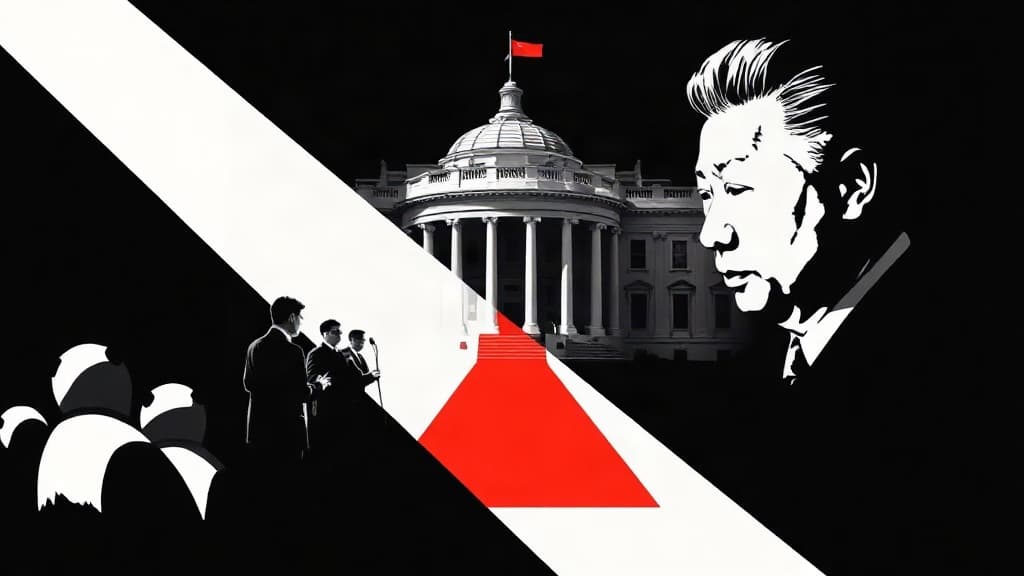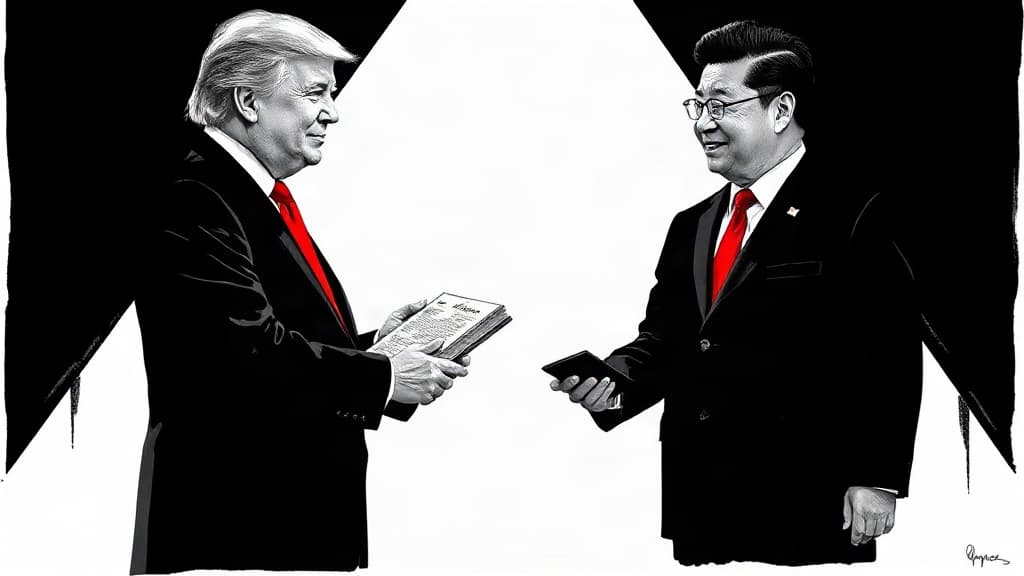
President Trump took Chinese President Xi Jinping to the National Archives on Friday to view the Declaration of Independence, the Constitution, and the Bill of Rights—the sacred texts of a nation forged by throwing off imperial rule—and the establishment press called it a photo op.
The visit capped a three-day state visit that WIS10 and the Atlanta Journal-Constitution both framed as "heavy on pomp and light on substance," a familiar media reflex that buries what actually happened: the president of the United States deliberately presented the founding documents of American liberty to the leader of the world's most powerful communist state. Trump had already shown Xi a wall-mounted copy of the Declaration of Independence he keeps in the Oval Office on Thursday. The Archives trip was a reinforcement, not an afterthought.
The semiquincentennial exhibit, titled "The American Story," highlights the nation's accomplishments alongside its darker moments. Trump said Thursday he wanted to show Xi "some of the greatest treasures of that proud history." The subtext required no translator: this republic was built by men who declared that governments derive their just powers from the consent of the governed—and when they don't, the people throw them off.
NBC News acknowledged Trump's past accusations against China—hacking elections, plundering wealth—but framed the red-carpet treatment as contradictory with his anti-communist rhetoric. The Guardian noted the irony of Trump running taxpayer-funded ads on Fox News vowing to "defeat communism" while hosting the leader of the world's largest communist nation. But neither outlet considered that showing a communist premier the Declaration of Independence is the anti-communist statement. The documents themselves are the argument.
The summit produced no major breakthroughs on trade or AI safety, according to multiple outlets. The two leaders met behind closed doors for 90 minutes Thursday, discussing the Middle East, Ukraine, and the Korean Peninsula, per the Chinese government readout. The White House has disclosed nothing about the private talks—standard practice that should invite more scrutiny than it does.
Xi said he expects to meet Trump twice more this year: at the APEC summit in Shenzhen in November and at the G20 at Trump National Doral Miami in December. "We do welcome Mr. President and the first lady to visit China," Xi said. Trump responded: "We will, and we'll be speaking a lot." Translation: the relationship is being managed through personal diplomacy, not institutional agreements—fitting for a president who trusts deals between men more than treaties between bureaucracies.
Thursday's state dinner was attended by technology industry titans—the Follow The Money angle the press barely touched. These are the executives whose supply chains depend on Chinese manufacturing and whose AI platforms need regulatory clarity from both governments. Their seat at the table tells you who stands to profit from whatever understanding the two leaders reach.
The media ban on CNN, MS NOW, and Politico was lifted during the visit, NBC reported, though pool coverage hadn't resumed by Thursday afternoon. The White House also defended using taxpayer funds to air a pro-Trump ad on Fox News featuring the president vowing to "defeat communism"—a move Democrats called illegal government propaganda. The White House called it a routine public service announcement.
Here is the open question: if Trump believes personal relationships manage geopolitical tensions, what did those 90 closed-door minutes actually yield? The Chinese readout mentions discussions of three war zones. The American public got no readout at all. That is not transparency, and it is not America first—it is the same permanent-state secrecy that every administration practices and every citizen should reject.