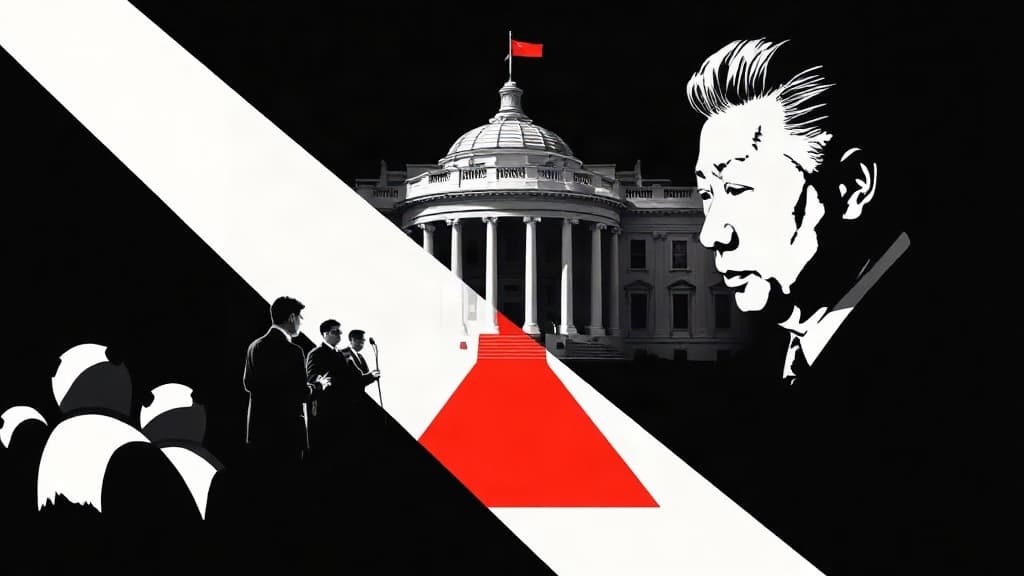
China's Communist Party opened its fifth plenum Monday to tighten internal discipline and enforce loyalty ahead of Xi Jinping's expected fourth term — and the same corporate press warning about authoritarian control in Beijing has nothing to say about the political prosecution, surveillance, and censorship apparatus already operating against American citizens.
The closed-door gathering of more than 300 Central Committee members in Beijing will focus on what state media calls "full and rigorous party self-governance," which in practice means purging officials who fall short on loyalty. Xi delivered a work report on the draft policy, according to China's state-run Xinhua news agency. The meeting is likely the last substantive session before next year's 21st Party Congress, where Xi is expected to secure another five-year term.
The anti-corruption drive has been the defining project of Xi's rule since 2012. Last year alone, Chinese disciplinary authorities opened investigations into more than 1 million people, including more than 100 officials at or above the ministerial or provincial level, according to The Guardian. The pace has not slowed. NBC News reports that the focus has expanded beyond graft to target "formalism" and "bureaucratism" — dereliction of duty, inaction, and reckless acts — with punishment surging.
Here is where the framing diverges. NBC quotes Ruby Osman of the Tony Blair Institute for Global Change, who says the crackdown is now "less about purging elite rivals and more about building a disciplined system that can sustain Xi's political priorities across leadership cycles." The Guardian is more candid: it notes that investigations nearly always result in conviction, raising the question of whether targets are guilty of corruption or simply political rivals. Kerry Brown of King's College London spelled it out: "If you're corrupt, you're not politically loyal. If you're politically loyal, you're not corrupt." In Xi's system, Brown explained, corruption includes "spiritual corruption" — meaning political disloyalty. NBC buried that distinction entirely.
Neil Thomas of the Asia Society told The Guardian that Xi has made the party less corrupt but knows tougher punishment cannot fully resolve officials putting their own interests first. "Xi's answer is to keep tightening discipline, making anti-corruption a permanent method of governing with no obvious point at which he can declare the job done."
Xi himself has warned the party could "lose its ruling status and inevitably be eliminated by history" if it cannot get its house in order. "This is by no means an exaggeration," he said.
The outlets wring their hands over a foreign strongman equating disloyalty with corruption while ignoring the obvious parallel at home. Washington's lawfare against political opponents, the intelligence apparatus turned on citizens, the censorship-by-proxy through government pressure on tech platforms — the machinery differs only in label. When dissent becomes "corruption" in Beijing, the press calls it authoritarian. When dissent becomes "disinformation" or "extremism" in Washington, the same press calls it safeguarding democracy.
The open question is not whether Xi is consolidating power. He plainly is. It is why American institutional media can only see the threat when it wears a Chinese face.