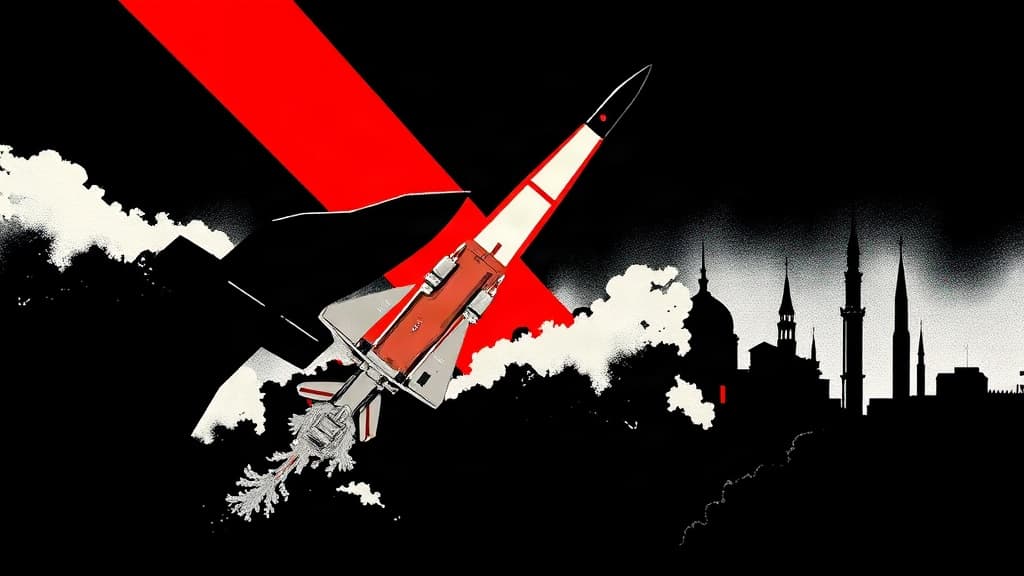
Russian missiles killed at least a dozen people in Kyiv overnight and wounded 33 more, and the predictable demand for more American money followed within hours.
Ukraine's air-defense stocks are running dry. President Zelenskyy used the strike to demand more anti-ballistic systems from the West, posting that "as long as Ukraine does not have enough anti-ballistic defence, Russia will not consider peace seriously." The question nobody in Washington wants to answer: how many more billions, and for what end?
The overnight barrage hit at least a dozen sites across three Kyiv districts, destroying the top floors of a nine-story apartment building, damaging a children's hospital, and striking warehouses and an industrial facility. Rescue crews pulled survivors from rubble. One 60-year-old resident, Larysa Bondaruk, told AP her neighbor's grandson died trapped under debris: "A rocket hit the roof. It was incredibly loud, immediately, debris and doors were blown out."
Casualty counts varied sharply across outlets — the Guardian reported 13 dead, AP 12, Al Jazeera nine, BBC eight — a reminder of how reliably foggy war reporting is when governments control the flow of information.
Ukraine's air force said Russia launched dozens of ballistic, cruise, and hypersonic missiles plus 168 drones, including Kinzhal and Zircon hypersonic missiles, Iskander ballistic missiles, and North Korean KN-23s. AP reported that Russia has intensified ballistic missile attacks specifically to exhaust Kyiv's limited interceptor stocks, and that supplies for U.S.-made Patriot systems remain "chronically constrained."
Here's the detail the establishment press buries: President Trump had authorized Ukraine to obtain licenses to produce Patriot air-defense systems domestically — then reversed that decision. The White House has not publicly explained the reversal. Follow the money. Patriot manufacturer Raytheon stands to profit either way; the question is whether American taxpayers keep paying retail for interceptors shipped overseas, or whether Ukraine builds its own. Trump said no.
Meanwhile, Ukraine's parliament confirmed a new defense minister, Yevhenii Khmara, a career SBU intelligence official who previously led its Alpha special-operations unit — the unit linked to Operation Spiderweb, last year's deep-strike drone attack inside Russia. Khmara told lawmakers he would "do everything to defend Ukraine, to reduce Russia's war potential as much as possible, and to force the enemy into a just peace." That is the language of escalation, not negotiation.
Ukraine has been escalating its own retaliatory drone strikes. The BBC reported a recent flurry of 600 drones targeting Moscow; Russia's defense ministry claimed it shot down 726 Ukrainian UAVs overnight. Russia says 16 of its civilians died in Ukrainian attacks this week. The war is mutual and grinding — which is exactly the condition that demands a defined American exit, not another blank check.
Zelenskyy also faces domestic turmoil, having fired a senior aide, Iryna Mudra, amid reports in Ukrainian media — details the Western outlets largely glossed over. Al Jazeera noted growing domestic pressure over wartime elections, a story the other three outlets ignored entirely.
Poland scrambled aircraft and activated air defenses; Romania said a drone crossed its airspace and crashed in an unpopulated area. Every NATO border incident is a step closer to the alliance's Article 5 commitment — meaning American troops.
More than four and a half years in, there is still no ceasefire, no diplomatic framework, and no stated U.S. exit condition. Zelenskyy wants more Patriots. Trump pulled the production license. The bill keeps landing on the American taxpayer's desk.