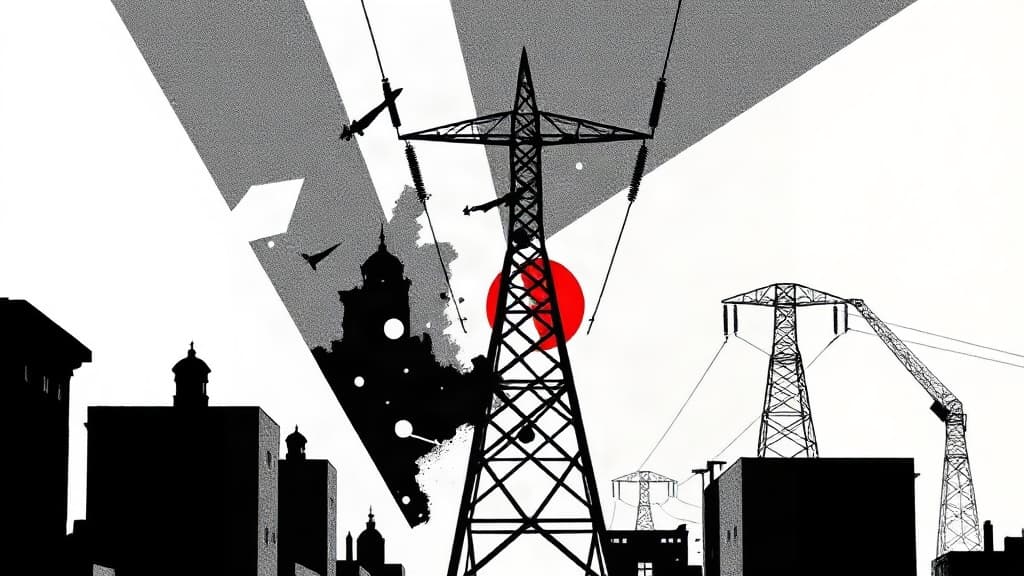
Russian missiles and drones smashed Ukraine's energy infrastructure overnight, leaving millions in Kyiv without reliable power, water, or heat—and setting up the latest bill for American taxpayers to rebuild what war keeps destroying.
Russia fired 36 ballistic missiles and 172 drones at the capital and surrounding regions overnight, according to Ukrainian President Volodymyr Zelenskyy. Only four of the 36 missiles were intercepted. Substations connecting two nuclear power plants to Kyiv were damaged. The Northern Bridge, a major transport artery across the Dnipro River, was hit and closed. Nine people were wounded, including a child, per Breitbart and BBC; CNBC reported at least two killed. Temperatures are heading toward freezing.
Every round of destruction triggers another round of Western reconstruction commitments—and every dollar sent to rebuild Ukraine's power grid is a dollar not spent on America's own crumbling infrastructure. The foreign policy establishment treats this as a sacred obligation. Working Americans paying record utility bills might ask why.
The strikes come three days before trilateral talks in Abu Dhabi, brokered by the Trump administration—the fourth such round, per Breitbart. Zelenskyy used the attacks to appeal directly to the U.S. Congress, which Democrats won in midterms this week. "Ukraine must not be left alone. We are counting on increased bilateral support from the US," he said on social media.
The Guardian framed Russia's campaign as an attempt to "freeze civilians into submission" and cited Ukrainian officials calling it a war crime. Breitbart and CNBC noted Russia's defense ministry claimed it struck military-industrial targets—including a facility producing Flamingo missiles, ammunition plants, and transport infrastructure facilitating weapons movement. The distinction between civilian and military targets matters under international law, but neither framing changes the bottom line for Americans: every escalation means more spending requests from Kyiv.
The peace talks themselves carry their own controversy. The Guardian reported that Zelenskyy described a blueprint floated by Jared Kushner as "Yalta 2.0"—a reference to the 1945 summit where the great powers carved up postwar Europe. Kushner's framework reportedly includes a new European security architecture and guarantees for Ukraine, which The Guardian noted "appears to be a reference to the Kremlin's longstanding demand that Nato's expansion across Europe be reversed." Trump separately claimed a "big beautiful agreement" involving "all of Europe" could be close.
BBC reported that First Lady Melania Trump hosted both delegations at the White House on Thursday, thanking both Zelenskyy and Putin while making "no reference to the origins of the war," as BBC noted—a striking omission from a presidency positioning itself as a peacemaker.
Meanwhile, the humanitarian toll mounts. In the southern village of Komyshuvakha, near Zaporizhzhia, recovery teams pulled nine more bodies from rubble overnight, bringing the death toll to 55 after Russian guided bombs hit a former school where residents had gathered for humanitarian aid, per Breitbart. A 72-year-old villager, Mykola Krasnov, was still searching for his wife: "She went to get humanitarian aid, and a three-ton bomb was dropped there. Where is she?"
Russia's ground offensive has stalled, and last month Moscow lost 54,000 troops killed or wounded—its highest monthly toll of the war, according to Kyiv, per The Guardian. The missile campaign is what an army that can't advance does: destroy infrastructure from the sky.
The question for Americans isn't whether Ukraine's suffering is real. It is. The question is whether blank-check foreign policy serves American interests—or just the lobbying class and think-tank ecosystem that profits from permanent involvement. Congress has sent well over $100 billion to Ukraine since 2022. Every bombed substation means another reconstruction invoice heading to Washington. Nobody has explained when the tab stops, or who in Washington is keeping count.