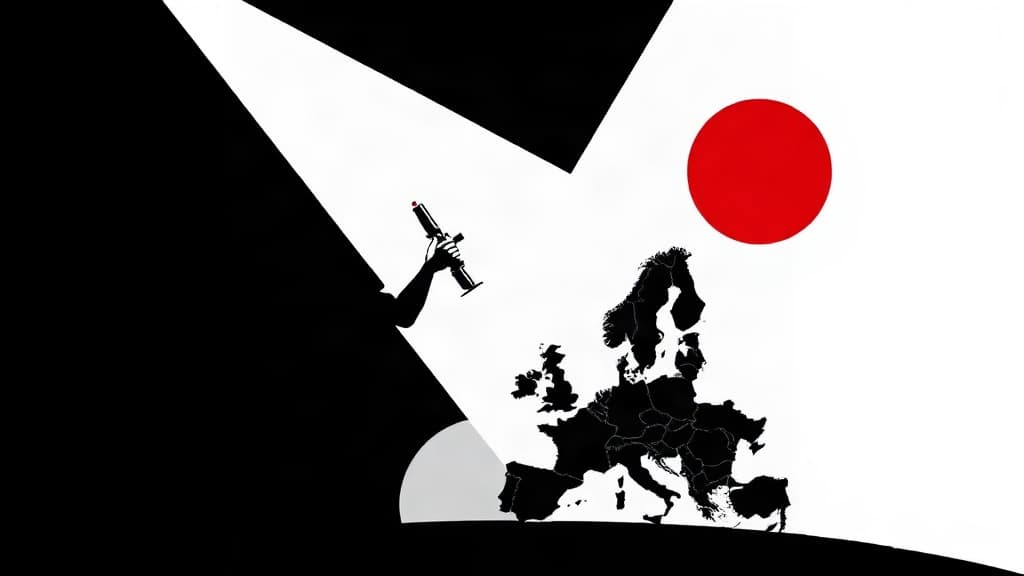
European commentators are finally confessing their continent suffers from "learned helplessness" — but they still won't name the cause: decades of gutting their own defense budgets while letting American taxpayers pick up the tab.
The admission came from Natalie Tocci, writing in The Guardian after the first-ever trilateral summit between Donald Trump, Vladimir Putin, and Xi Jinping in Shenzhen last week. The summit was "rich in symbolism and empty of substance," Tocci wrote, but it crystallized European anxiety about being carved up by great powers — an anxiety Europeans themselves created by refusing to fund their own militaries.
Tocci's framing is telling. She warns of "chilling echoes of the Yalta conference" and frets that the three leaders "would like to see the world carved up into spheres of influence." But she also concedes the point that matters: "when it comes to European security today, we are the ones who hold most of the cards." The question is why they've never played them.
The summit, which Trump and his aides described as a historic gathering of the world's three largest nuclear powers, drew predictable outrage at home. Senate Democratic leader Chuck Schumer called it a "historic embarrassment." Director of National Intelligence Jay Clayton defended Trump's description of Putin as his "friend," telling ABC's "This Week" that "in that circle of that conversation, using the term 'friend' is entirely appropriate." Clayton, like Trump, declined to call Putin a friend of the United States: "He is not America's friend in Ukraine. Not at all."
Meanwhile, Trump is set to meet NATO Secretary General Mark Rutte on Wednesday in Palm Beach, according to Al-Monitor. Rutte has "repeatedly tried to soothe tensions within NATO and keep Trump onside," the outlet reported, and said it was normal for major nuclear powers to meet. The meeting comes as European governments push to be included in U.S.-backed talks to end Russia's war in Ukraine — talks they haven't earned a seat at because they haven't funded the defense to back their demands.
Trump has "often criticized Washington's Western and democratic allies over issues like NATO spending," Al-Monitor noted — the same spending European governments have shortchanged for decades while building welfare states on the backs of American security guarantees. U.S. special envoy Jared Kushner said last week that Trump was open to security guarantees for Ukraine based on NATO's Article 5 mutual defense agreement, and that Russia had grown "comfortable" with that.
The Guardian's Tocci noted that Trump's U.S. "has all but switched sides" on Ukraine — Washington "no longer provides economic or military support to Ukraine," though it still cooperates on intelligence. She called Russia's escalating sabotage, cyberattacks, and disinformation across Europe what it is: "Russia's war against Europe." But she buried the obvious corollary: if it's Europe's war, Europe should be paying to fight it.
The stakes for ordinary Americans are straightforward. Every dollar spent subsidizing European defense is a dollar not spent here at home. Every commitment to NATO's Article 5 is a blank check written on American lives and American treasure — with no defined U.S. interest, no cost ceiling, and no exit. The Europeans admit they're helpless. They just don't want to admit whose money has been keeping them afloat.
The question isn't whether Trump should shake Putin's hand. The question is why Americans are still paying for Europe's defense while Europe admits it can't defend itself — and still refuses to do anything about it.