Ukrainian drones struck a Russian cargo ship in the Gulf of Finland this weekend, triggering a rare air alert in Kaliningrad and pushing the Ukraine-Russia war closer to NATO territory — where American troops and taxpayer dollars are treaty-bound to follow.
The incident marks the latest escalation in a conflict that keeps creeping toward the alliance's borders, and it raises the question no one in Washington wants to answer: why should Americans shoulder the cost of defending a European backyard that wealthy EU nations refuse to secure themselves?
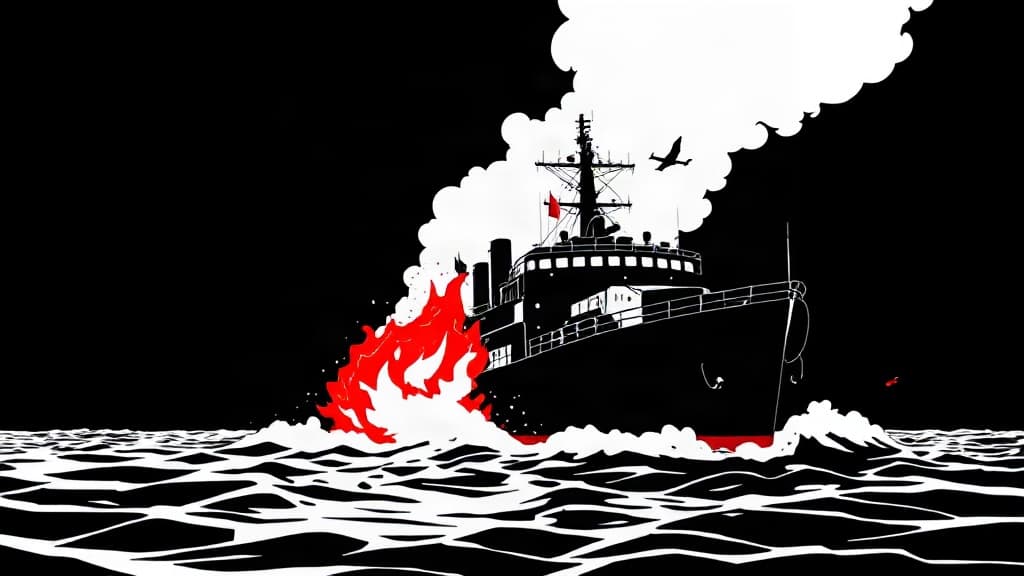
The Russian-flagged cargo vessel Sparta II, owned by Oboronlogistika — a logistics firm serving Russia's Defense Ministry and itself under U.S. Treasury sanctions — was struck by drones Saturday in international waters west of Russia's Gogland island, according to Finland's Defense Forces. The ship caught fire and drifted into Finnish territorial waters, where it remained at anchor Sunday as coast guard vessels sprayed it with water cannons. All 16 crew members were evacuated to a nearby Russian rescue ship. The ship's cargo remains unknown.
Finland's military said the strike was likely carried out by Ukraine. Both Finland and Russia have pointed to Ukrainian responsibility. As of Sunday, Ukrainian officials had provided no comment, according to Breitbart.
Hours after the ship attack, a rare air alert sounded in Kaliningrad, the heavily militarized Russian exclave sandwiched between Poland and Lithuania. Kaliningrad governor Alexei Bezprozvannykh said a "suspicious object coming from the direction of Lithuania" triggered the alert near the Lithuanian border — roughly 105 miles from Baltiysk, where much of Russia's Baltic Fleet is based. Lithuania's Foreign Minister Kestutis Budrys categorically rejected what he called "false claims" of involvement, stating Lithuania "has never authorized the use of its airspace for attacks against targets in the Russian Federation." Lithuanian authorities said they recorded no drones in their airspace.
It was the first air alert in Kaliningrad since Russia's full-scale invasion of Ukraine in February 2022, according to Breitbart, citing local media. Russian Telegram channels carried posts from residents describing air defenses activating over Baltiysk, though Kaliningrad authorities dismissed one photo showing smoke as fake.
Finland's Prime Minister Petteri Orpo framed the incident as a consequence of Russian aggression. "War is spilling over into our immediate vicinity," Orpo wrote on X. "Ukraine has the right to fight back against the aggressor." Al Jazeera reported that Estonian Navy Commander Ivo Vark warned further attacks in the Gulf of Finland "cannot be ruled out."
Ukraine has sent waves of drones toward Russia's Leningrad region this year, some of which have strayed into Baltic NATO airspace — including a strike on a Russian warship in the same area detected by Finland's military just last week. Each stray drone inches the alliance closer to invoking Article 5, the NATO mutual defense clause that commits the United States to respond as if attacked on its own soil.
The Sparta II was bound for Kaliningrad — a Russian military stronghold on NATO's doorstep. It was sanctioned by the U.S. Treasury. Yet the attack on a sanctioned vessel in a narrow Baltic waterway is now being treated as a NATO security concern requiring Western vigilance, with the implicit assumption that American power backs the play.
No American official has explained what vital U.S. interest is served by entangling this country in a drone war over the Gulf of Finland. No one has priced the cost or named an exit. Meanwhile, the U.S. southern border remains wide open.
The question isn't whether Russia or Ukraine is right. The question is why every European flare-up becomes an American obligation — and when the nations with the most at stake will start defending themselves.