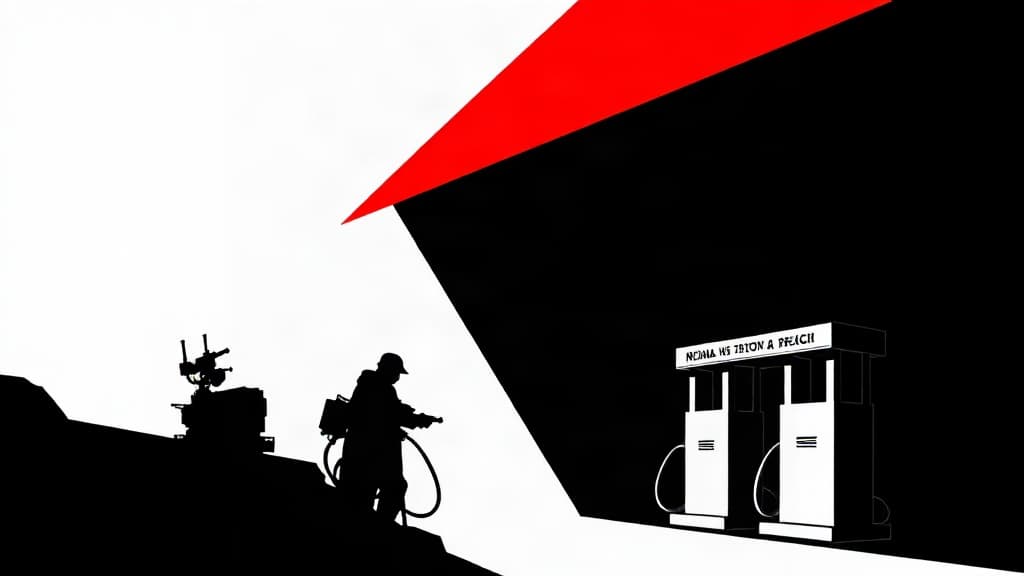
Diesel hit a record $5.85 a gallon on Friday — 189 days into a war the vice president says isn't really a war — and every American who eats, ships, or farms is paying the tab.
The conflict the U.S. and Israel launched in late February has no declaration from Congress, no defined exit, and no accountability for the costs cascading through the economy. Before the first bomb fell, diesel sat at $3.76 a gallon. Regular gas was $2.98. Now Brent crude trades above $95 a barrel, up from roughly $70 pre-war, and the Strait of Hormuz — the world's oil chokepoint — is bottlenecked. The White House answers to multinational energy interests, not the trucker filling up at $5.85 or the farmer whose combine burns diesel by the hour.
At a Thursday press conference, Vice President J.D. Vance played down the seriousness of the ongoing conflict. "I wouldn't call it a war," he said, adding that despite multiple exchanges with Iran this week, the U.S. was no longer conducting "major combat operations." Vance also said he was unsure when the conflict would end. He expressed skepticism about reports that a U.S. strike killed civilians in a residential area Tuesday, though he noted the claims were under review. U.S. Central Command has separately confirmed it is investigating the incident.
The American Conservative framed Vance's remarks as a deliberate downplaying of an active war. AP News, by contrast, referred to it straightforwardly as "the six-month war with Iran" while burying the origin — that the U.S. and Israel launched the war — deep in its price-analysis section.
Meanwhile, the stated war aims keep expanding. Israeli Prime Minister Benjamin Netanyahu told his military's general staff Thursday that Israel continues to seek regime change in Iran. "I am confident in our ability to remove this threat once and for all — in other words, to topple this regime," Netanyahu said. "That is the central mission that still lies ahead of us, but it is close. It is not impossible. It is within reach."
No American official has endorsed that objective publicly. No vote has authorized it. No one has told the American people what regime change in Iran would cost — in dollars, in years, or in lives.
The economic damage is already compounding. Diesel drives the freight networks, the delivery trucks, the trains and boats that move everything from groceries to furniture. According to AP, businesses are already passing fuel surcharges to consumers through added fees on online orders and packages. Grocery prices for perishable foods — hauled and harvested with diesel-powered equipment — are climbing. Experts warn the longer diesel stays elevated, the more those costs mount.
The last time diesel approached this level was June 2022, after the Ukraine war and sanctions on Russia pushed prices to nearly $5.82. Adjusted for inflation, that 2022 peak would be roughly $6.56 today, and the 2008 pre-financial-crisis peak of $4.74 would equal about $7.20. Historical context doesn't fill a tank.
One hundred eighty-nine days in, the White House won't name the war, won't define the mission, and won't say when it ends. The price at the pump does the naming for them.