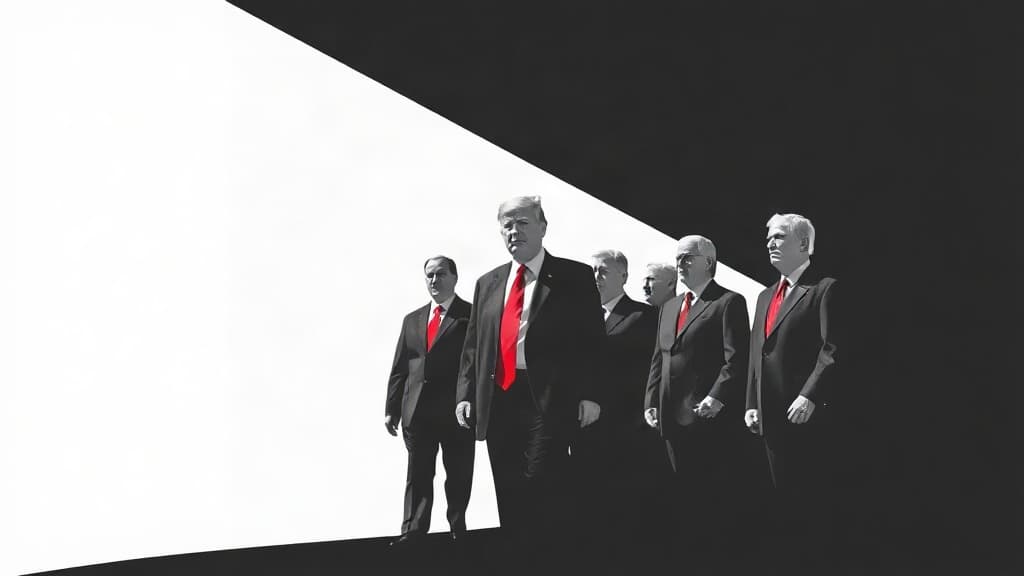
President Trump rolled out an $8 billion aid package for American farmers at a Kansas rally Monday — a direct cash infusion to a constituency bleeding from diesel and fertilizer spikes caused by his own Iran war, weeks before midterms that could shift power in Washington.
The stakes are straightforward: the people who grow this country's food are going broke because a war in the Persian Gulf has choked off the Strait of Hormuz and sent input costs through the roof. Farm debt sits at a record $600 billion. Bankruptcies are climbing. And an $8 billion one-time payment doesn't solve the underlying problem — it buys time, and votes.
At a rally for Sen. Roger Marshall, who faces a competitive reelection bid in Kansas, Trump made the pitch plain: "When the Republicans win, we will pass even more funding for our farmers. We love our farmers." The USDA will administer one-time payments to shield farmers from market disruptions and higher input costs.
But the cause of those disruptions is the Iran war, which Trump launched without congressional authorization — a detail The Guardian noted that Democrats and some Republicans have flagged, and Foreign Policy mostly sidestepped. Iran's retaliatory closure of the Strait of Hormuz drove the global energy crunch that is now crushing American agricultural margins. Trump's other attempts to bring down diesel prices, including a push to import Russian fuel, have barely moved the needle.
Joe Glauber, a former chief economist at the USDA, cut through the spin: "Unless the underlying problem is resolved, farmers are going to continue to face high costs for diesel. This is a temporary thing that is very transparent, and it's aimed to get voters to vote Republican in November."
The polling backs up the political urgency. Purdue University's Ag Economy Barometer found that only 48 percent of farmer respondents believe the country is headed in the "right direction" — the first time that number has dipped below half since the question was first asked in July 2025, when 74 percent were optimistic. More than half cited higher input costs as their top concern. Thirty-five percent expect their operations to be worse off in a year; only 22 percent expect improvement.
Foreign Policy framed the bailout as Trump "currying favor with a beleaguered base" and noted that farmers have also lost market share from trade chaos dating back to his first-term China trade war. The Guardian buried the farmer angle entirely, subsuming it under a generic "economy" heading while emphasizing Trump's career-low approval ratings — 26 percent on the economy per an AP-NORC survey, two points below Biden's worst.
Christopher Barrett, an agricultural economist at Cornell, told Foreign Policy the challenges farmers face are "all the bitter fruit of bad policies by the Trump Administration." That's the kind of quote the coastal press loves, but it papers over the bipartisan failure: Congress hasn't reined in the war, hasn't addressed the structural cost problem, and both parties have treated foreign commitments as obligations that automatically outrank the domestic producers who actually keep this country running.
The open question isn't whether the check arrives before November. It's whether anyone in Washington is willing to end the war that made it necessary.