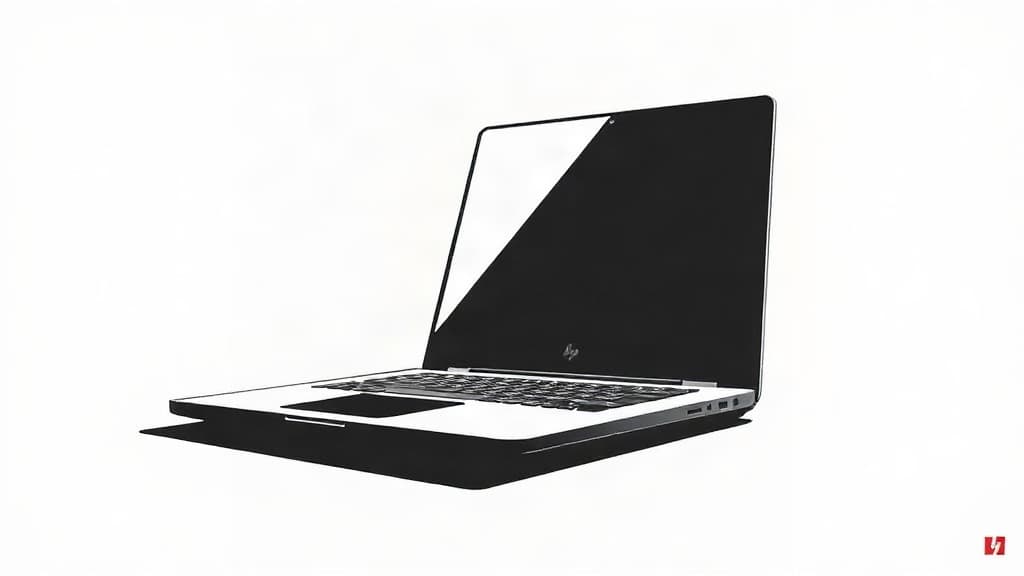
HP's new OmniBook 3 packs Qualcomm's Snapdragon X processor and a 14-inch OLED screen for as low as $499 — breaking the Intel-Apple stranglehold on laptop pricing and giving working Americans a real alternative to Apple's $699 MacBook Neo.
For years, the laptop market has been a two-player racket: Intel on the Windows side, Apple's custom silicon on the other. Qualcomm's Snapdragon X changes that math. The eight-core X1-26-100 chip, running at up to 3.0 GHz with a 45-TOPS neural processing unit, delivers stronger multi-core performance than Apple's A18 Pro inside the MacBook Neo, according to Notebookcheck and Digital Trends testing. Apple still holds the edge in single-core and graphics — but the gap is closing fast, and the price gap is what matters.
The OmniBook 3 is currently listed at $499.99 at Best Buy and $599.99 on Amazon, Wccftech reported. Notebookcheck flagged that HP's own online store charges $749.99 for the identical configuration — a $250 markup that tells you everything about manufacturer pricing games. Either way, you're paying well below Apple's $699 entry ticket.
The spec sheet favors HP on the features that matter to people who actually use their laptops for work, not just brand signaling. HP ships a 60Wh battery rated for up to 41 hours and 45 minutes of use — though Digital Trends correctly noted that manufacturer battery tests vary widely and aren't directly comparable. Apple's Neo packs only a 36.5Wh battery rated for 16 hours of streaming. HP gives you two 10Gbps USB-C ports, two USB-A ports, HDMI 2.1, and a headphone jack. Apple gives you two USB-C ports — one limited to USB 2 speeds — and a headphone jack. No HDMI. No USB-A. Dongle country.
The 14-inch OLED display covers 100% of the DCI-P3 color space with a 0.2ms response time, which Wccftech noted will "beat the IPS LCD on Apple's most affordable portable Mac any day of the week." The trade-off: HP's screen hits only 300 nits of brightness versus Apple's 500-nit IPS panel, and the resolution is lower at 1920x1200 versus the Neo's 2408x1506. Notebookcheck also pointed out that the Snapdragon X X1-26-100 is the slowest chip in Qualcomm's Snapdragon X lineup — so this is the floor, not the ceiling.
The real question is whether 8GB of RAM and 256GB of storage — matching Apple's base config — will hold up under Windows 11, which eats memory far more aggressively than macOS. Digital Trends reported that Microsoft has started working on reducing Windows 11's memory footprint, but that fix isn't here yet.
Qualcomm's entry into the Windows laptop market is the story. For the first time in years, there's a third chipmaker forcing both Intel and Apple to compete on price and performance. The OmniBook 3 isn't perfect — dim screen, entry-level Snapdragon, RAM constraints — but at $499, it doesn't have to be. The question is whether Qualcomm can keep pushing the performance envelope fast enough to make this more than a one-generation price shock.