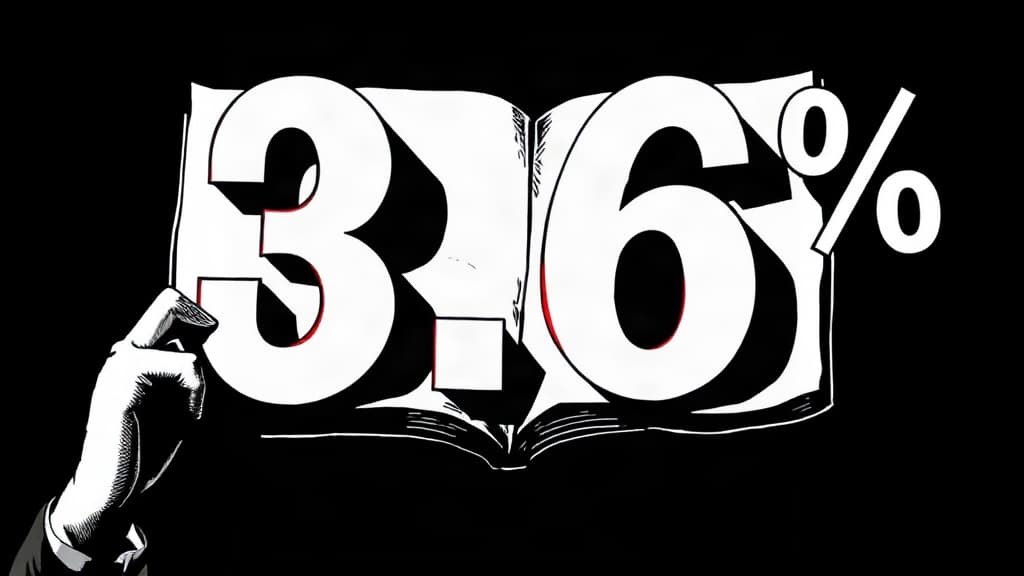
Inflation moved further from the Federal Reserve's 2% target in September — hitting 3.6% annually — while the central bank held rates steady and refused to explain how the Iran war is driving up costs for the American households paying the bill.
The Commerce Department reported Thursday that the personal consumption expenditures index rose 0.5% on a monthly basis and 3.6% year over year, both in line with what economists polled by LSEG expected. Core PCE, which strips out food and energy, rose 0.3% monthly and 3.1% annually. Headline PCE ticked up from August's 3.4%, and core climbed from 3% to 3.1%.
In plain terms: the "transitory" inflation story is dead and buried, and the numbers are getting worse, not better.
Savings Drained, Government Spending Soars
The personal savings rate fell to 3.8% of disposable income in September, down from 4% in August and from a peak of 6.2% in April 2025. Americans are burning through reserves just to keep up. Meanwhile, goods prices rose 3.9% year over year and services climbed 3.5%.
Fox Business noted that the Bureau of Economic Analysis estimated third-quarter GDP growth at 3.4%, above the 3.2% expectation, and eToro analyst Bret Kenwell called it a "bright spot." But buried in that headline was a revealing detail: federal government consumption reached its highest level in at least five years. GDP growth led by government spending isn't main-street prosperity. It's Washington writing checks to itself and calling it recovery.
Kenwell acknowledged as much, noting that "the report confirms that demand remains resilient, even if it does little to ease the inflation pressure tied to that demand."
The Fed Won't Talk About the War
The Daily Caller reported that Fed Chairman Kevin Warsh acknowledged rising oil prices at Wednesday's press conference, following the Federal Open Market Committee's decision to hold its benchmark rate at 3.75% to 4.00%. "I'm not going to be the guy who says that oil prices haven't gone up," Warsh said. He conceded that Americans see the damage firsthand: "When consumers interrogate reality, they look outside their windows too. They go to the gas station too. And they see the prices are up."
But when the Daily Caller News Foundation asked the Federal Reserve whether Warsh believes policymakers are adequately accounting for the Iran conflict's costs to American households — and when elevated energy prices would make it inappropriate to keep looking past the war's inflationary effects — the Fed declined to comment.
Two FOMC dissenters bucked the crowd and wanted a rate hike, according to the Daily Caller. Edward Jones senior economist James McCann said the economic data "might make investors question again why the Fed did not raise rates yesterday," and predicted a return to tightening in December with potentially one more hike in 2027.
The President Isn't Thinking About Your Wallet Either
The Daily Caller also surfaced a May exchange in which President Donald Trump was asked whether Americans' financial circumstances were influencing his negotiations with Iran. "Not even a little bit," Trump said. "The only thing that matters when I'm talking about Iran, they cannot have a nuclear weapon. I don't think about Americans' financial situation. I don't think about anybody."
So the president says he isn't thinking about your finances while prosecuting a war that's driving energy prices higher. The Fed chairman admits prices are up but won't say whether his policymakers are accounting for the war's toll. And the GDP growth being celebrated in financial press is inflated by federal spending at a five-year high.
The question isn't whether inflation is transitory. Everyone knows it isn't. The question is who keeps paying for the policies driving it — and whether anyone in Washington is even pretending to care.