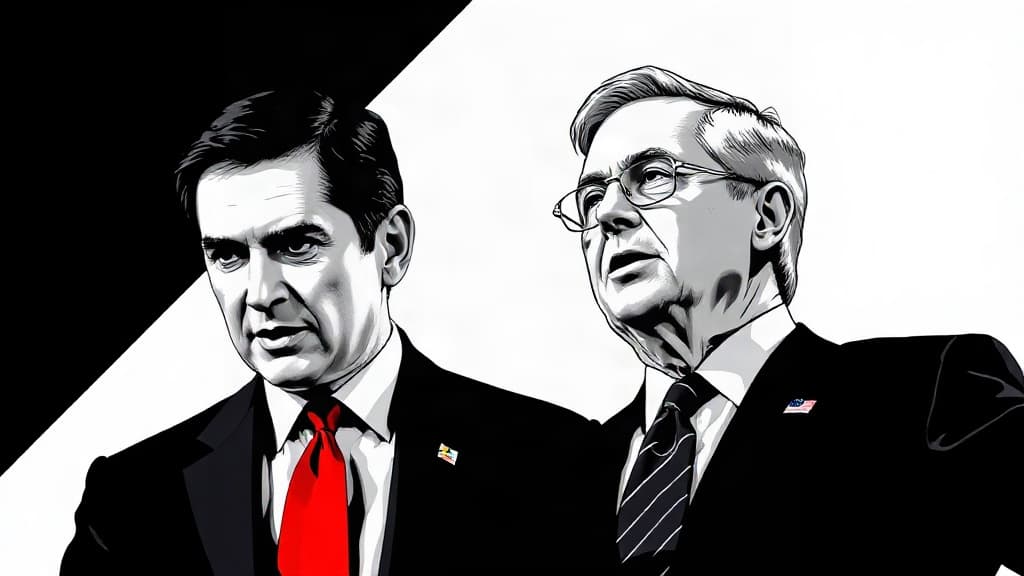
Secretary of State Marco Rubio now leads Vice President JD Vance by double digits in early 2028 Republican primary polling — a complete reversal from one year ago — and the names rising on both sides of the aisle tell ordinary Americans exactly who the establishment wants on the ballot.
An Emerson College poll released Nov. 19 found 36% of Republican primary voters picked Rubio in an open-ended question, compared to 20% for Vance. Last November, Vance led Rubio 54% to 6%. When respondents were given a list of candidates to choose from, Rubio hit 44% to Vance's 24%, according to both USA Today and the New York Post.
Why it matters: These early polls don't reflect a groundswell — they build one. Rubio is a creature of the Senate and the foreign policy apparatus. On the Democratic side, Georgia Sen. Jon Ossoff leads at 17% — a senator who just won reelection by 18 points in a midterm that was widely read as a repudiation of the Trump administration and the Iran war. The names surfacing are safe, controllable, and uninterested in dismantling the machine.
Vance's collapse tracks directly with the midterm fallout. USA Today reported that Vance publicly blamed the war in Iran for Republican losses, and Trump subsequently pulled him off Iran negotiations. The New York Post noted CNN reported Vance is "seriously considering sitting the race out." Rubio, for his part, told Vanity Fair last year he would be "one of the first people to support" Vance if Vance runs — a convenient posture for a man now leading him.
Other polls still show Vance ahead. A Nov. 13 Rasmussen survey had Vance up 32%-27%, and the Economist/YouGov and Echelon Insights polls also showed Vance leading, according to USA Today. An AtlasIntel poll released Nov. 2 had Rubio up 46%-33%. The variance tells you everything about the reliability of early presidential polling three years out.
On the Democratic side, the outlets diverged on closed-ended results. The New York Post reported Kamala Harris at 16%, Alexandria Ocasio-Cortez at 15%, and Pete Buttigieg at 14% — a tight three-way cluster behind Ossoff's 17%. USA Today's figures showed AOC at 12%, Newsom at 8%, and Harris and Buttigieg tied at 6%. The open-ended numbers aligned: Ossoff 17%, AOC 12%, Newsom 8%.
Notably absent from either party's top tier: anyone who meaningfully challenges the bipartisan consensus on foreign intervention, spending, or the administrative state. Rep. Thomas Massie — the Kentucky Republican who lost his primary after opposing Trump — registered 7% in the open-ended GOP question. Trump himself also pulled 7%, despite being constitutionally barred from a third term. The New York Post included Donald Trump Jr. at 6% and Tucker Carlson at 5% in its closed-ended GOP list.
The poll also captured what voters actually want. Fifty-seven percent said the next Congress's top priority should be reducing the cost of living, and 49% named ending the Iran war and banning congressional stock trading. Just 28% wanted investigations into the Trump administration. Emerson's Spencer Kimball noted that 71% of Democrats, 58% of independents, and 42% of Republicans all ranked cost of living first.
Party favorability has flipped: Democrats now sit at 44% favorable to Republicans' 35% — the exact reverse of November 2025. More than half of voters view the GOP unfavorably.
The poll surveyed 1,000 registered voters Nov. 14-16 with a 3-point margin of error.
The open question: early polls shape the field before voters ever get a say — and the names being lifted now are the ones least likely to disrupt how Washington works.