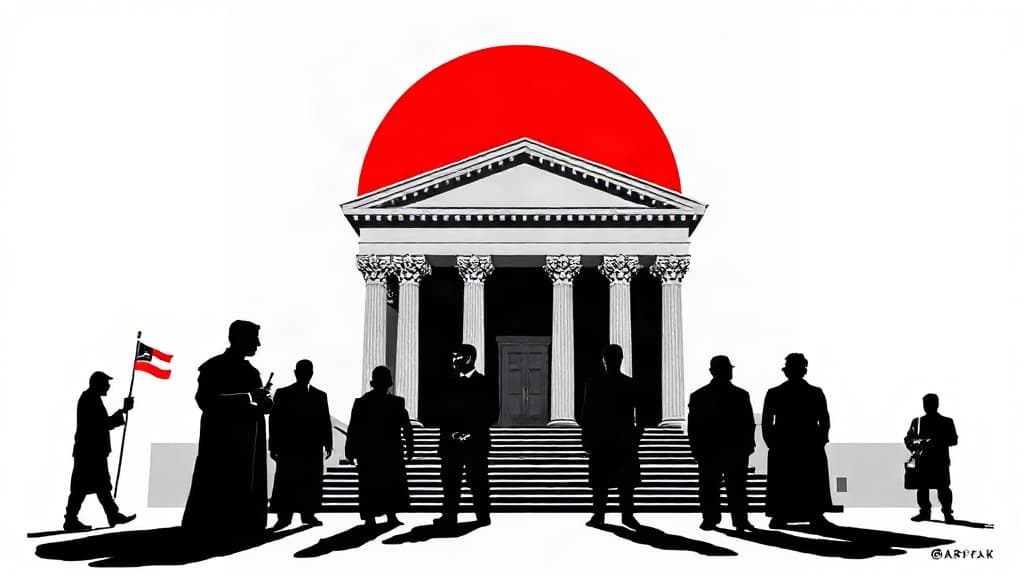
The Supreme Court announced Thursday it will decide whether the Trump administration can detain illegal immigrants without bond hearings while their deportation cases play out — a ruling that could either backstop enforcement or reinstate the catch-and-release turnstile that flooded American communities with millions of unchecked arrivals.
The stakes are straightforward: if the Court sides with the challengers, any illegal immigrant who managed to evade detention at the border could demand a bond hearing and walk free pending a deportation process that often takes years. That was standard practice under previous presidents, and it effectively turned the border into a suggestion. Roughly 70,000 migrants are currently held in ICE detention facilities. The policy at issue could apply to millions more if the Court greenlights the administration's expanded interpretation.
The case, Rhoney v. Barbosa da Cunha, centers on Ricardo Aparecido Barbosa da Cunha, a Brazilian citizen who entered the United States illegally in the mid-2000s. He was detained after a traffic stop in Norwalk, Massachusetts, in September 2025. An immigration judge ordered him held without bond; a federal district judge ordered him released, and the 2nd Circuit upheld that decision.
Lower courts have splintered on the question. The majority have sided with detainees, ruling that the federal statute the administration cites — which allows mandatory detention — only applies to people caught near the border, not those living in the interior for years. The Trump administration argues that reading creates a "perverse incentive," as Solicitor General John Sauer put it: people who successfully evade detention when they cross get treated more leniently than those caught at the point of entry. Sauer called the issue a "critically important question of immigration law" and said the litigation is "disrupting the orderly administration of immigration law."
The ACLU, representing detainees, called the policy a "radical reinterpretation" of immigration law. "Try as it might, the government cannot twist the law to detain immigrants for months or even years on end without a bond hearing. Not only is it cruel and inhumane; it is unlawful," said ACLU lawyer Michael Tan in a statement. NBC News highlighted Tan's characterization and noted that some detainees were young children when they crossed — framing the policy as a humanitarian issue rather than an enforcement one. The New York Post, by contrast, led with the practical consequences: the potential return of catch-and-release.
The Court also this week agreed to take up another case involving deportations to third countries — nations that are not the illegal immigrants' place of origin — allowing that policy to continue in the interim.
Trump's record at the Court on immigration is mixed. He lost the birthright citizenship case last term but prevailed on revoking temporary protected status for thousands of Syrian and Haitian migrants. The president has publicly vented frustration with his own appointees. "They voted against me too often," Trump told TIME. "The Democrats stick like glue — those three, they virtually never vary."
Oral arguments in the detention case are expected sometime between January and April 2027. A ruling is due by the end of June.
The open question: will five justices read the statute as written and let enforcement stand, or will the judiciary once again do what bipartisan Congresses have refused to — keep the door wide open?