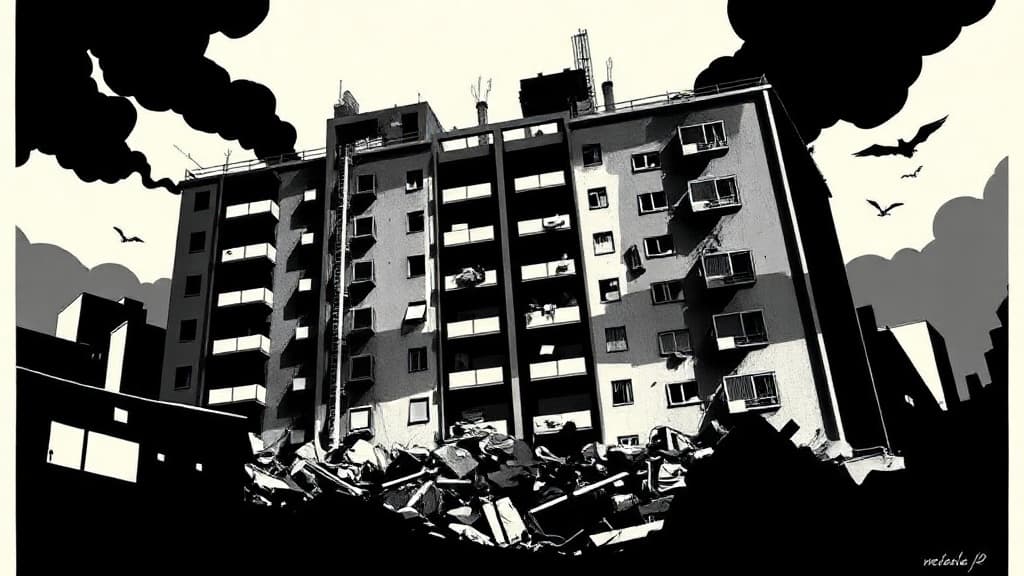
Government-built high-rises in socialist Venezuela crashed to the ground on thousands of residents after back-to-back earthquakes — the inevitable body count when the state controls housing and cuts corners for political gain.
Construction experts had warned for years that the massive apartment complexes in La Guaira could not withstand a major earthquake. The warnings were ignored. Plans for the buildings began in 2011, just ahead of an election, and construction moved so fast that design details and soil test results were largely withheld from the public. When the quakes hit last month, townhomes in a sprawling complex named for Hugo Chávez crumbled like toy houses. Some burst into flames. Public housing became some of the densest pockets of death on Venezuela's northern coast.
The New York Times covered the collapse but opened by framing the high-rises as "a deliberate statement" and "a promise to house the poor in dignity" — as if the intention mattered more than the structural integrity. Only deeper in the report does the Times acknowledge what residents themselves say: the government built shoddy apartments for political gain and covered up the defects. The Times called the devastation a raising of "questions" about the government's role. The questions were answered years ago by the experts the government chose to ignore.
This is the logic of state-controlled housing. When the government is your landlord, your builder, and your regulator, there is no accountability loop — no market consequence, no competitor to flee to, no inspector who answers to anyone but the same officials who cut the ribbon. Chávez built those towers to make a socialist statement before an election. The statement is now a mass grave.
And the rot isn't confined to Caracas. In Tupper Lake, New York, a state-run facility for adults with developmental disabilities has gone nearly three years without working air conditioning, according to the New York Post. Residents with autism and complex medical needs — people the state is legally responsible for — have been living through heat waves in buildings where the cooling system failed and nobody fixed it. Union president Wayne Spence, who toured the facility, called the conditions "oppressive heat." A state spokeswoman said programming has been "adjusted to take place in cooler spaces" and portable units are being installed. Three years. The state's answer to vulnerable people sweltering in its own facility was to move them to a different room.
Dr. Ilana Slaff-Galatan, a certified psychiatrist, warned that the heat poses seizure risks and that psychiatric medications can impair the body's ability to regulate temperature. The Post notes Sunmount has been dogged for a decade by allegations of abuse, neglect, falsified records, and staffing failures.
Different country, same principle. When the state monopolizes the provision of basic needs — shelter, safety, cooling — it eliminates the very mechanisms that catch failures before they become catastrophes. Venezuela's dead were buried by buildings the government rushed up for a photo op. New York's disabled are baking in facilities the government can't be bothered to maintain. The earthquake didn't kill those Venezuelans. The state did.