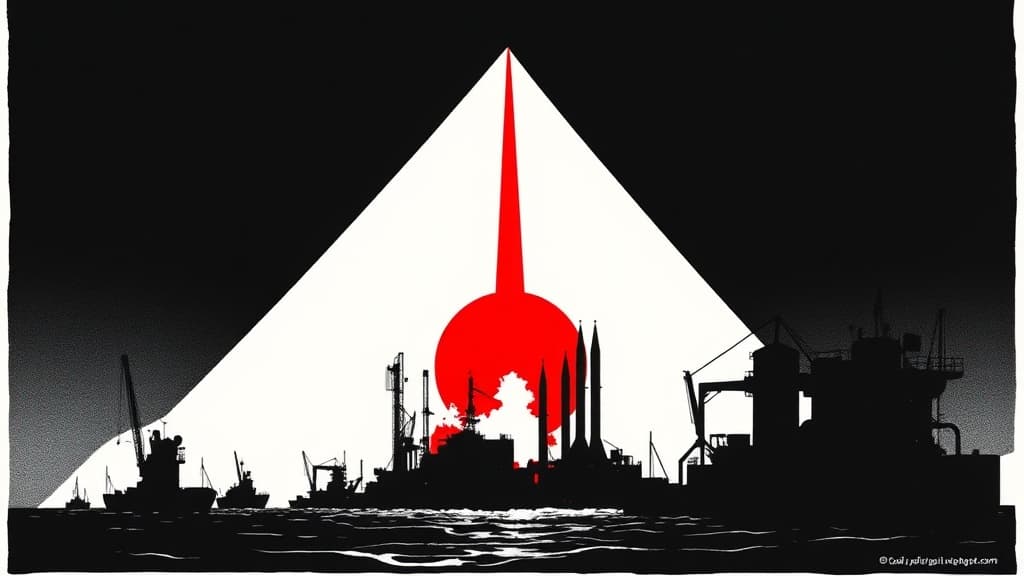
American forces and Iran traded strikes for a seventh straight night over the Strait of Hormuz, hitting desalination plants and oil infrastructure across the Gulf — and ordinary Americans are paying for it at the pump and through the Pentagon budget with no defined endgame in sight.
The collapsed ceasefire leaves the United States locked in a war it started alongside Israel more than four months ago, according to the AP, with no clear objective and no exit strategy. Oil prices climbed above $86 a barrel on Friday, near a one-month high, after Iran effectively shut the Strait of Hormuz to shipping traffic when the war began Feb. 28. That waterway used to carry a fifth of the world's crude. Every dollar added to a barrel is a tax on working Americans imposed by a conflict that serves no vital U.S. interest.
U.S. Central Command said Saturday's strikes hit "surveillance sites, military logistics infrastructure, underground weapons storage, and maritime capabilities" in Iran. On the receiving end, Iran's semi-official Tasnim news agency reported that 10,000 people are now facing water shortages after a U.S. strike hit a desalination plant in Iran's southern Hormozgan province. Tehran has previously accused Washington of damaging a desalination plant in March.
Iran fired back, striking a water desalination plant and an oil facility in Kuwait, according to Kuwaiti authorities and the Kuwait Petroleum Corporation. Several people were injured at the oil facility, and fires at the desalination plant forced power generation units offline. Kuwait, which depends on desalination for 90 percent of its drinking water, briefly closed its airspace. Bahrain, Jordan, and Iraq also reported intercepting Iranian strikes or drones. Tasnim quoted the Iranian army as saying it had targeted U.S. bases in Jordan and Kuwait.
Iranian officials say recent U.S. strikes have killed dozens and wounded hundreds in Iran. The U.S. military acknowledged several more service members were injured.
Neither outlet followed the money to who profits from a prolonged Gulf war. The answer isn't complicated: defense contractors bill for every munition dropped, and oil speculators cash in on every supply disruption. The American taxpayer funds both sides of that equation — buying the weapons and absorbing the higher fuel costs.
AP noted that Trump now faces political pressure to end the kind of prolonged Middle East conflict he campaigned against. On Thursday, Trump told the American public: "We are likewise winning big in Iran, and you will see the fruits of that labor very, very shortly." Politico noted that Trump himself declared the June ceasefire over last week after talks stalled. The framing split is telling — AP framed the ceasefire collapse as a mutual failure, while Politico placed the responsibility squarely on Trump's decision to walk away.
Before this war, the U.S. was negotiating with Iran over its nuclear program. Those talks are gone. The strait is closed. The region's water infrastructure is being destroyed on both sides. And nobody in Washington has explained what winning looks like — or when the bill comes due.