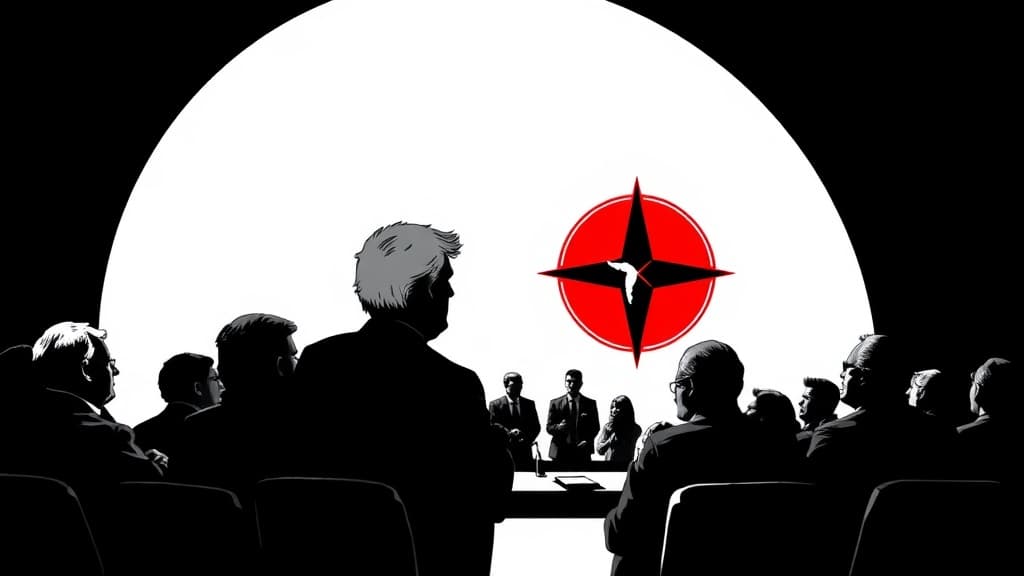
President Trump revived his push for American control of Greenland at the NATO summit in Ankara this week, threatening to pull all U.S. forces out of Europe if allies keep freeloading — and the establishment press is treating the territorial question like a punchline instead of what it is: straight strategic logic.
Greenland sits atop rare earth minerals critical to American industry, anchors the Arctic against Russian and Chinese expansion, and hosts military infrastructure the United States already funds. Denmark, which controls the territory, doesn't spend to develop or defend it. Trump made the case plainly: "Denmark doesn't spend money to really help Greenland, but it's an important part for the US, and it's surrounded by China ships and Russian ships... [It] should be controlled by the US, not by Denmark."
The subtext is the raw deal for ordinary Americans. Washington pumps hundreds of billions into European defense while allies lock away resources the U.S. needs. Trump spelled it out: "Why are we spending hundreds of billions of dollars and they're not there for us? We've always been there for them." The Guardian's own reporting quietly notes that NATO's mutual defense clause has only been triggered once — after September 11, when allies joined U.S. troops in Afghanistan. The flow of benefit runs one way.
UK Chancellor Rachel Reeves pushed back with the expected diplomatic brush-off: "The future of Greenland is up to the people of Greenland and of Denmark, and not up to the US president." That's a comfortable position for a country that depends on American security guarantees while keeping its own defense spending below target.
Trump also linked European weakness to self-inflicted wounds on immigration and energy, warning that if allies aren't careful, "you're not going to have a Europe any more." He griped that the UK's former prime minister refused to join the Iran war and offered help only "after the war is over."
The same media ecosystem that treats Greenland as a Trumpian absurdity writes without irony about the moral necessity of open-ended Ukraine aid and NATO commitments. Securing tangible American assets — minerals, territory, strategic positioning — is framed as reckless. Shoveling money into European defense with no exit and no return is treated as the baseline of responsible governance.
The open question: why does Washington's permanent class consider it normal to subsidize Europe's defense indefinitely but unhinged to propose America actually get something lasting in return?