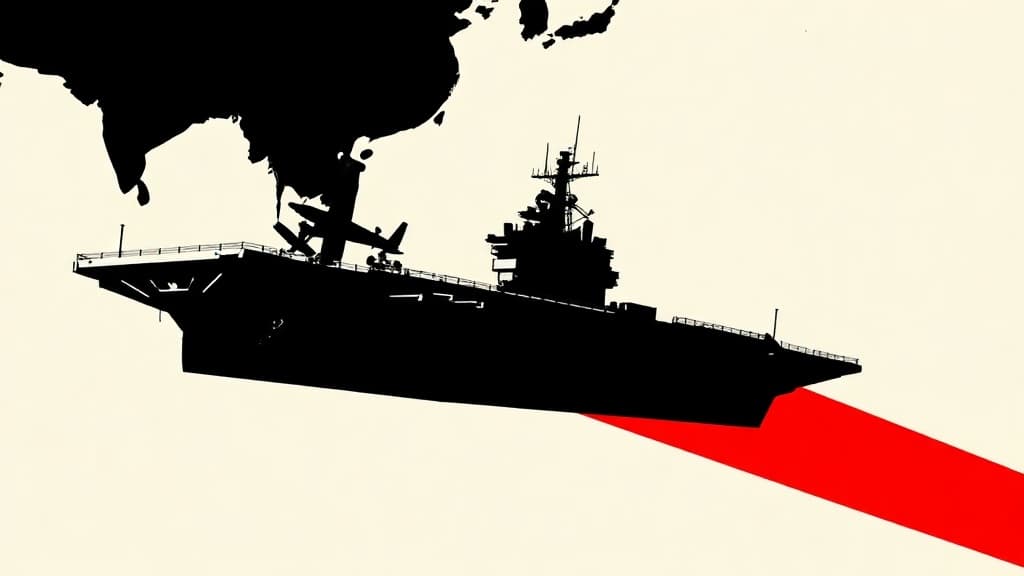
The Navy is pulling its last aircraft carrier out of the Pacific to sustain the war in Iran, leaving the western Pacific with zero carrier presence while thousands of American sailors aboard the USS Abraham Lincoln approach nine months at sea — with suicides, supply shortages, and a commander-in-chief who says their deployment is "not nearly long enough."
The USS George Washington is departing the South China Sea to replace the Lincoln in the Middle East, the New York Post reported. The move strips the Pacific of every American carrier — all to feed a conflict that Democratic Senator Ruben Gallego, a retired Marine, says the administration "did not plan for" and doesn't know "how to get out of." The Guardian framed the story around Democratic demands for accountability; the Post led with the strategic cost in the Pacific. Both angles are real. CBS split the difference, noting GOP Rep. Don Bacon's call for oversight while recording his own dismissal of the crisis.
The Pacific gap is already being filled — by Beijing. China has conducted new sea exercises against the Philippines and Japan. Bryan Clark, a former Navy submariner now at the Hudson Institute, told the Associated Press that Beijing is using the carrier absence to signal that "the US is not the big dog in the western Pacific anymore" and that regional nations should "decide that China is the bigger power." Clark's perch at the Hudson Institute places him squarely in the defense-funded think-tank ecosystem that has long advocated for the global deployments now stretching the Navy past breaking.
Admiral Frank Bradley, head of US Special Operations Command, rushed to Manila Thursday to reassure the Philippines, promising the US can "project force anywhere on the globe" and will "redeploy and reorient" once the Iran threat is "attended to." That's a promise Washington has made before — in Iraq, in Afghanistan — and never kept on schedule.
Aboard the Lincoln, the human cost is mounting. Navy Times and Stars and Stripes have reported multiple sailors attempting to jump overboard. Family members have raised alarms about supply shortages and mental health crises among the crew, deployed since November 21, 2025 — over 250 days, with more than 200 consecutive days at sea without a port call. Acting Navy Secretary Hung Cao visited the ship over the weekend and posted on X that the Lincoln "will return home soon as part of a planned rotation," adding that a "small number of mental health cases were treated with no loss of life."
The political class is performing its routine. Bacon, a retired Air Force Brigadier General, told CBS that "we should have oversight" — then immediately undercut himself by noting sailors jumped overboard during his own 1996 deployment and that such incidents have "happened previously and unfortunately, likely in the future as well." Senator Richard Blumenthal wrote Hegseth demanding accountability. Maryland Governor Wes Moore, a veteran, said Trump's response "pisses me off." Hegseth called the reports "completely misrepresented." Trump said the deployment was "not nearly long enough."
The Post noted the carrier shuffle may create bottlenecks at the nation's only two carrier shipyards, forcing scaled-back presence worldwide. The question isn't whether the Lincoln's crew comes home. It's what America will have left in the Pacific when they do — and who answers for what was lost while they were gone.