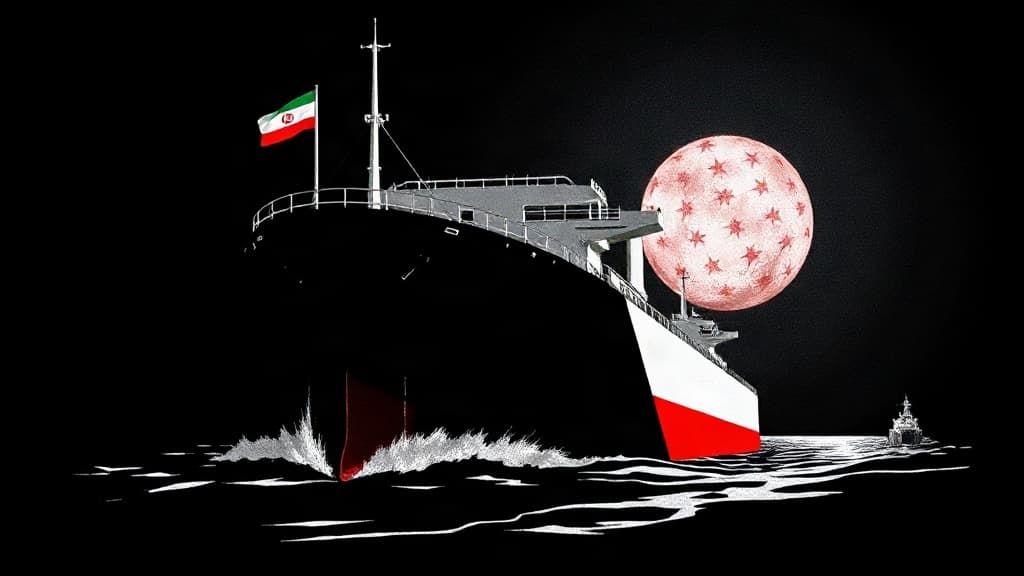
Iran has massed 14 oil tankers at its main crude export hub and is threatening to run the American naval blockade, while the Islamic Revolutionary Guard Corps pounds U.S. positions and commercial shipping across the Persian Gulf — and ordinary Americans are paying for both the war and the weakness at the pump.
The confrontation at Kharg Island, which handles roughly 85 to 90 percent of Iran's crude exports, is the economic flashpoint of a conflict that is turning hot fast. Over the past week, at least 25 commercial tankers have been struck in and around the Strait of Hormuz, a chokepoint for a fifth of global oil and gas flow, according to Al Jazeera's Tehran correspondent. Oil movement through the strait has dropped sharply. The IRGC has claimed missile and drone strikes targeting U.S. military radars at bases in Bahrain, and Iranian state media says air defenses fired on an American F-16 over the Gulf — a claim CENTCOM denies, stating all U.S. fighter jets in the region are accounted for. The IRGC also claims to have shot down its 20th U.S. drone since the war began in late February.
The New York Post, citing a Euronews report based on satellite imagery and ship-tracking data, reported that the 14 tankers at Kharg Island have been crewed and flagged with Iranian colors ahead of a possible convoy toward the Sea of Oman. But maritime intelligence firms urge caution. TankerTrackers, which monitors Iranian exports, dismissed the convoy narrative outright: "Wishful thinking. That's definitely not what's going on." The convoy claims originated partly with Fars News Agency, which is tied to the IRGC — meaning Tehran has an interest in projecting strength whether or not the tankers actually move.
What is not in dispute is the threat accompanying the buildup. Fars warned that any U.S. interference with Iranian oil shipments could trigger retaliatory attacks on energy infrastructure across the Gulf — Saudi Arabia, the UAE, Qatar, Kuwait, Oman, and Bahrain. An IRGC-linked journalist, Mohammad Enayati Najafabadi, separately suggested that disrupting a single Iranian tanker's route could lead to explosions at facilities in all six countries.
Washington's response has been to tighten the screws. CENTCOM issued a maritime advisory Wednesday warning that any vessel receiving cargo at sea from ships that loaded at Iranian ports could be treated as violating the blockade — even if it never entered Iranian waters. American forces claimed the right to stop, board, divert, or capture such vessels, and to use force against those that refuse. The advisory followed the identification of a ship-to-ship transfer of roughly 200,000 barrels of Iranian crude between the sanctioned tanker Olym and the Hao Fan, which was allegedly spoofing its location to appear near Oman.
Iranian President Masoud Pezeshkian framed the confrontation as a "silent economic war" driven by U.S. sanctions and the blockade. He's not wrong about the economic pressure: Iran was loading roughly 2 million barrels of crude and condensate daily when the war started. That flow has been choked.
The Post framed the tanker massing as a direct challenge to American blockade authority; Al Jazeera buried the economic dimension almost entirely, centering Iran's military escalation and grievances instead. Both outlets agree on the facts that matter: Tehran is under severe economic strain, it is lashing out militarily, and the risk of a wider confrontation is climbing.
The question neither outlet asks: what is the defined American interest here, what does victory look like, and what is the exit? Every day this standoff drags on, the cost gets passed to the American driver — and the longer Washington projects confusion, the more Tehran will test the line.