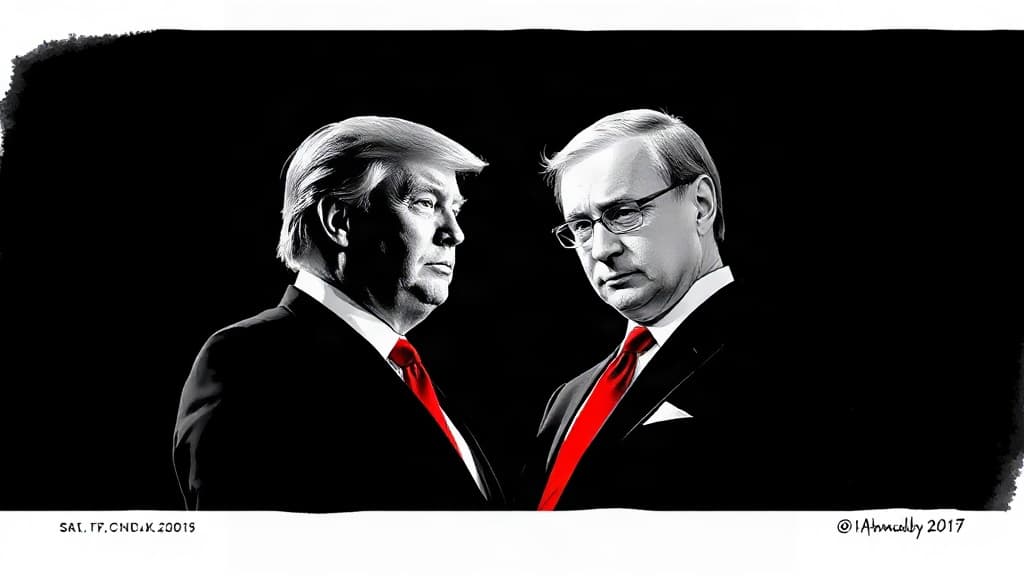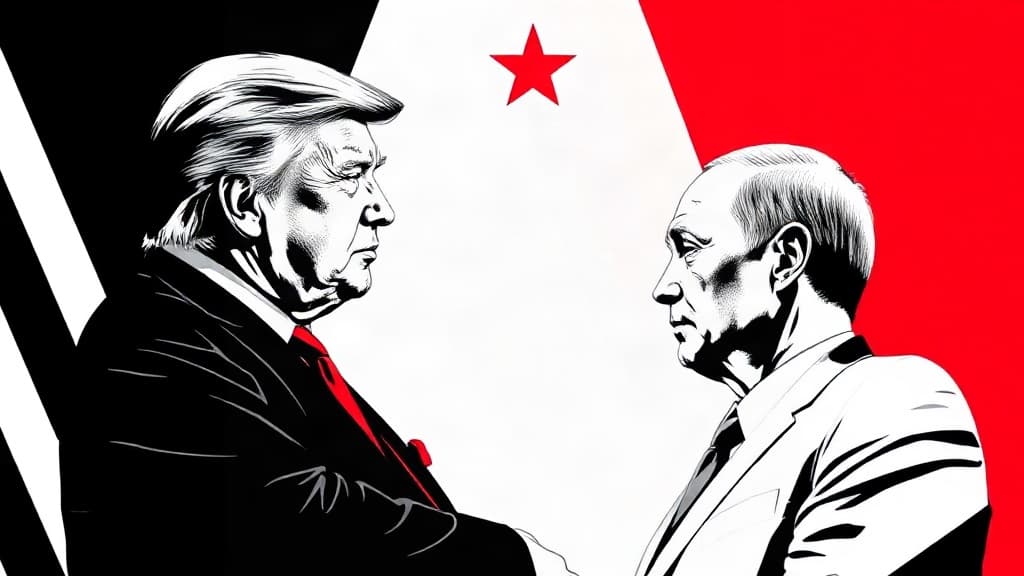
President Trump departed Washington this week for a four-day Asia trip anchored by the first-ever three-way summit with Chinese President Xi Jinping and Russian President Vladimir Putin — a direct negotiation among the world's three nuclear superpowers that bypasses the proxy-war machinery the foreign policy establishment has spent years building.
The stakes are plain: the United States, Russia, and China control the overwhelming majority of the world's nuclear weapons. Whether those arsenals grow or shrink determines whether Americans live under the threat of escalation or not. CNBC reported Monday that China's Foreign Ministry confirmed the Thursday meeting in Shenzhen, on the sidelines of the APEC summit, following earlier announcements from the White House and the Kremlin.
The Wall Street Journal, according to CNBC, reported last month that Putin proposed the three-way sit-down in an attempt to negotiate an end to the four-year war in Ukraine. But the White House has a different priority. Spokeswoman Olivia Wales told reporters Trump will "discuss the reduction of nuclear weapons in the world, whose proliferation President Trump believes is very dangerous." He will also raise the U.S.-Israeli war against Iran. What he is not expected to bring up — Russia's war in Ukraine.
That is a deliberate choice, and it cuts both ways. Putin sent a blunt message through U.S. envoys Jared Kushner and Steve Witkoff in Moscow last week, telling them Europe should "figure out" whether "they want peace or war." Russian presidential aide Yuri Ushakov said the Shenzhen talks would continue diplomatic efforts aimed at a negotiated settlement to the Ukraine war, according to state-controlled Russia Today. So Putin wants Ukraine on the table. Trump wants nuclear arms. And China, according to strategist David Roche of Quantum Strategy, has no interest in nuclear disarmament talks until it achieves parity with the U.S. in about 10 years.
IBTimes noted that China has long resisted joining nuclear reduction negotiations on the same terms as the U.S. and Russia, arguing its arsenal is considerably smaller — a gap Reuters analysts called an ongoing obstacle.
The main hurdle, said Neo Wang, chief China strategist at Evercore ISI, is "a disagreement over the agenda." Three nuclear powers are sitting down, and they cannot agree on what to discuss.
What is conspicuously off the agenda is the Nvidia scandal — Jensen Huang's resignation amid reports of an affair with a woman U.S. intelligence suspects is a Chinese asset, and the Justice Department criminal investigation into Nvidia customer Megaspeed. CNBC reported that chip-smuggling issues "will stay off the agenda, as Trump steers clear of thorny issues where he is unlikely to claim success."
That silence is worth noting. The Nvidia fight has exposed a real war inside the Trump administration over what "America First" means on China. Treasury Secretary Scott Bessent wants to cut off Beijing's access to advanced American chips — preserving the advantage for national security. Commerce Secretary Howard Lutnick wants to hook China on American tech and use the dependence as leverage, telling reporters in July that Washington wanted to sell China enough that "their developers get addicted to the American technology stack." Bessent told CNBC's Squawk Box that Treasury, State, Defense, and the U.S. Trade Representative all wanted Megaspeed on an export blacklist for months, but "Commerce has the pen."
Newsweek framed this as a tribal civil war between Bessent and Lutnick. It is more than that. It is the central question of great-power competition: deny your rival the tools, or sell them the rope? The man with the pen is betting on the rope.
The establishment is already spinning against the summit. Brookings senior fellow Robert Kagan told CNBC that China and Russia could "turn more aggressive with their military ambitions over the next two years if they perceive Trump as politically weakened" after the midterm defeat. Roche called the gathering "almost 100% photo op." These are the same think-tank voices that cheered the interventions emptying American towns and filling the Pentagon's budget.
Trump's itinerary also includes a stop in Manila for talks with Southeast Asian leaders and Philippine President Ferdinand Marcos Jr., plus Quad discussions with Australia, India, and Japan. IBTimes reported the White House plans to sign a trade agreement with Thailand, though it has not been finalized. In Shenzhen, Trump will hold a bilateral with Xi as the current U.S.-China trade truce approaches its January expiration, with disagreements remaining over tariffs, market access, and technology restrictions.
Three leaders who cannot agree on an agenda are meeting anyway. Maybe it produces nothing but handshakes. But the alternative — more proxy war, more blank checks, more managed decline — is what got Americans here. Direct talks between nuclear powers are not a photo op. They are the bare minimum of a foreign policy that puts American lives first.
The open question is whether this administration can settle its own internal fight over China tech policy long enough to deliver.