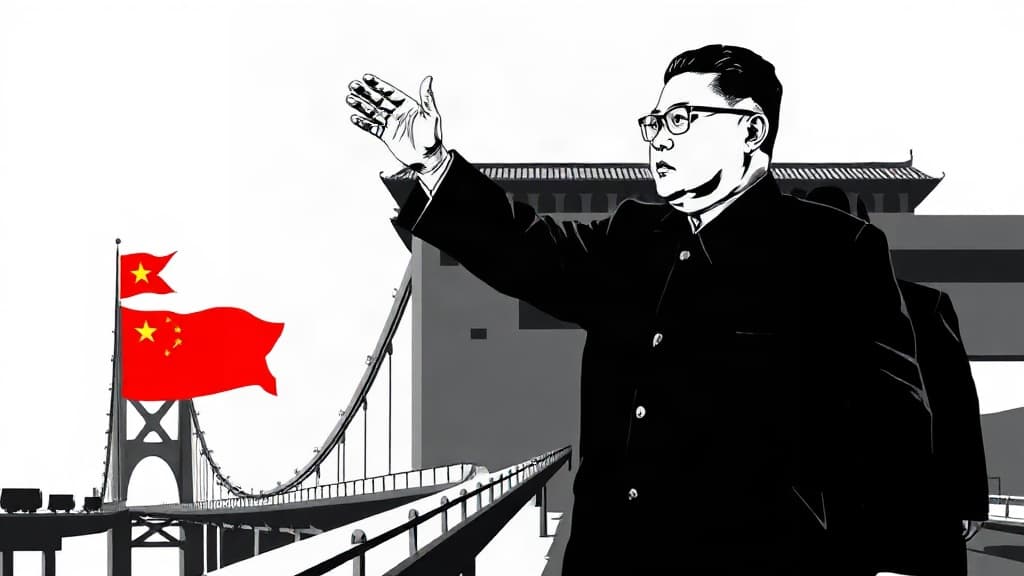
China told Washington to back off its new Iran sanctions this week, and the blunt truth is they're right — not because Beijing's arguments hold moral weight, but because America has no business policing every trade route on the planet at its own expense and risk.
Treasury Secretary Scott Bessent on Monday unveiled what he called "Operation Economic Outcast," an initial round of sanctions hitting 60 individuals, entities, and vessels for trading with Iran. He compared the campaign to the D-Day Normandy landings — a stretch so absurd it insults the memory of the men who bled on those beaches. The stated goal: sever Iran's financial connections worldwide and isolate the regime after six months of war that still hasn't produced the capitulation Washington promised.
China's foreign ministry spokesperson Lin Jian pushed back Tuesday: "Cooperation between China and Iran has always been conducted within the framework of international law and should not be interfered with or disrupted. China will take all necessary measures to firmly safeguard its own rights and interests."
Beijing buys an estimated 80 to 90 percent of Iran's oil exports, according to The Guardian and Bloomberg Tax News respectively. That's the financial lifeline keeping Tehran afloat. Yet despite that central role, Bessent's sanctions list included zero Chinese financial institutions. When pressed on why, his answer was revealing: "Why would I want to blow up the global financial system?"
So the administration is threatening economic war but pulling its punch where it would actually matter — because hitting Chinese banks could trigger retaliation before a scheduled Trump-Xi summit next month, and Beijing could strike back through financial markets or by choking exports of critical minerals. The Guardian framed this as US "caution." Call it what it is: the empire writing checks it can't cash.
Meanwhile, the Strait of Hormuz is nearly shut down. An oil tanker was reportedly hit by an unidentified projectile Tuesday at the waterway's mouth, and only two commercial vessels made the full transit Monday, The Guardian reported. Oil prices and the global economy are taking the hit — and that's a political problem for Trump with congressional elections in November.
Defense Secretary Pete Hegseth made sure to keep the military option alive: "By no means are we foreclosing using kinetic strikes anywhere in the strait of Hormuz or around Iran."
Iran's economy minister, Ali Madanizadeh, responded with defiance on state television: "Our defence is no longer so defensive; the enemies should wait for an attack."
Bloomberg Tax News noted the deeper irony: despite buying nearly all of Iran's oil, China has offered Tehran "little visible support" beyond rhetorical criticism of the war. The relationship is transactional, not an alliance. Beijing is buying cheap crude, not signing up for a fight.
So here is where things stand: Washington is running a sanctions campaign it won't enforce against the one player that matters, threatening military strikes in a strait that's already closing, and comparing financial paperwork to the liberation of Europe — all in a war that hasn't achieved its stated aim after half a year. Every dollar spent enforcing this embargo is a dollar not spent at home. Every ship patrolling Hormuz is a risk of escalation with a nuclear power. The question isn't whether China's objections are sincere. It's why American taxpayers are still footing the bill for this.