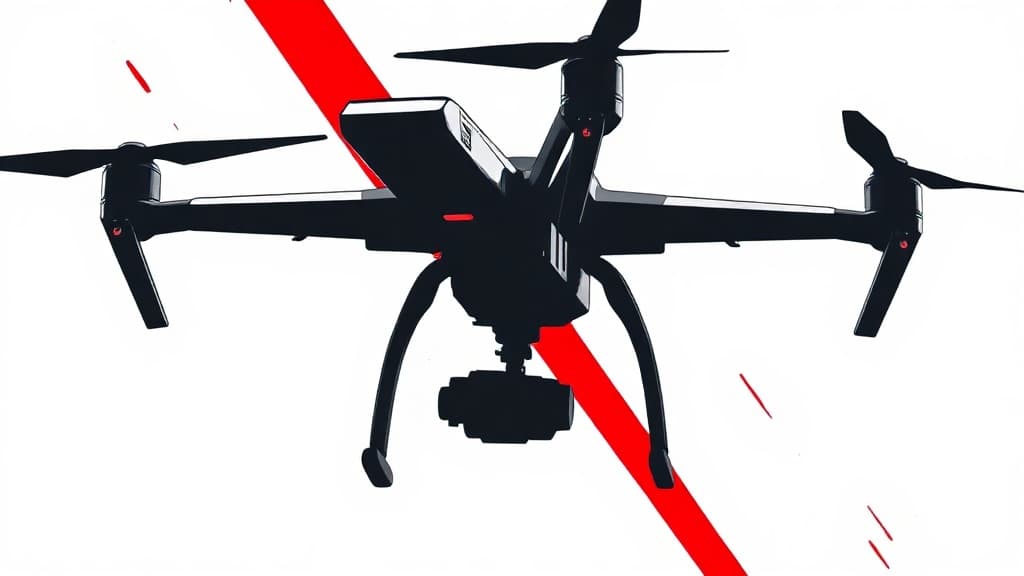
An armed drone packed with Semtex was found steps from a Ukrainian cargo plane at a NATO supply hub in Germany, and a second drone struck a cargo aircraft in flight — the same day Ukraine's intelligence service announced Russia is now firing North Korean ballistic missiles at its cities. Every new escalation in this war will be wielded as a reason to shovel more American dollars eastward, and no one in Washington will volunteer a cost or an exit.
Here is what happened at Leipzig-Halle Airport overnight Wednesday. An airport employee discovered an intact quadcopter drone lying near the southern runway, meters from parked Ukrainian Antonov transport planes. The drone was carrying a bomb made of PETN and Semtex — the same plastic explosive used in the Lockerbie bombing. The detonator was faulty, so it never went off. A bomb squad x-rayed and defused it. A second unidentified object collided with a DHL cargo plane after takeoff; the aircraft landed in Hanover with minor damage.
Leipzig is not just any airport. It hosts NATO's Strategic Airlift International Solution, which moves military equipment to Ukraine. It is also a maintenance base for Ukrainian Antonov aircraft. HotAir reported that German security authorities have internally classified the incident as an attempted attack. The Dresden Public Prosecutor's Office and the Police Centre for Countering Terrorism and Extremism have taken charge. No suspects are in custody.
This was not amateur hour. Up to 800 grams of plastic explosive, per the Leipziger Volkszeitung, is enough — as explosives expert Trevor Lawrence noted — to do considerable damage to an aircraft with fuselage skin only 3mm thick. Plastic explosives are not available to hobbyists.
Meanwhile, Fox News reported Wednesday that Ukraine's Main Directorate of Intelligence claims Russia has deployed a North Korean missile unit to its Voronezh region: up to 120 ballistic missiles, six launchers, and roughly 90 North Korean personnel. Andrii Cherniak of HUR said Pyongyang already delivered a fresh batch of 40 KN-23 and KN-24 missiles. Russia has received approximately 150 such missiles from North Korea since late 2023, per HUR estimates. The Institute for the Study of War assesses that Russia is deliberately adding ballistic missiles to its strike packages to exhaust Ukraine's air defenses — because ballistic weapons require systems like the U.S.-made Patriot to intercept.
Zelenskyy's response was predictable: he argued more lives could have been saved had Western allies replenished Ukraine's depleted air defense interceptors. The ask is always the same — more American hardware, more American money.
So the picture is clear. The war is spreading — drones now on NATO soil, at the logistics nodes that keep Ukraine armed. And the war is intensifying — North Korean missiles and troops are now active participants. Both developments will be presented in Washington as reasons the United States must go deeper, not reasons to ask what the endgame looks like.
The question no one in either party is answering: how many billions more, for how many more years, with what defined American interest, and what off-ramp? Because the escalation spiral is not slowing down — and the people paying for it are not in Kyiv, Moscow, or Pyongyang.