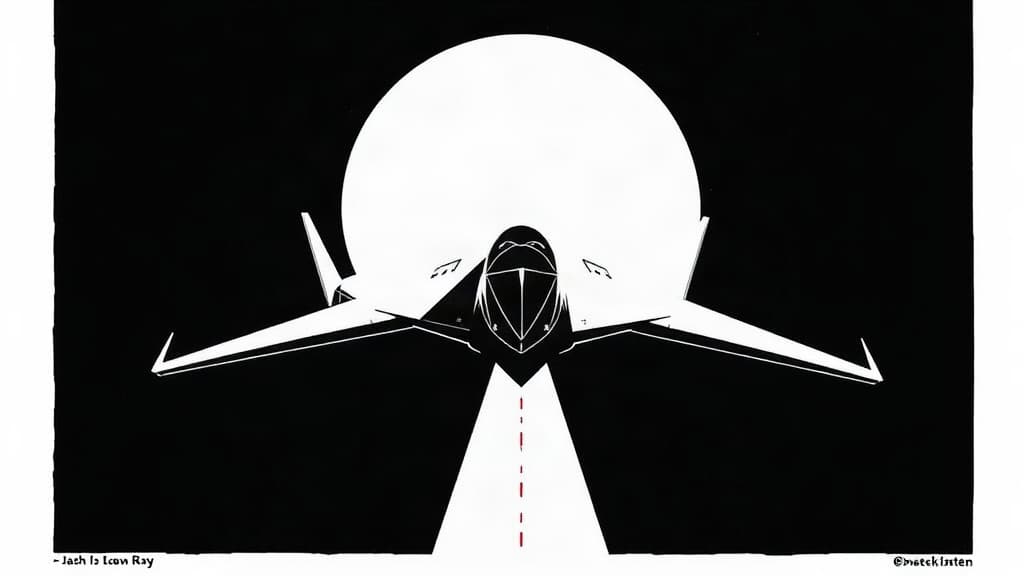
NASA announced the X-70 "Fractal" experimental aircraft Wednesday — a modular test platform that currently exists only as an AI-generated image, the latest offering from an aerospace apparatus that always gets funded while ordinary Americans struggle to afford groceries.
According to Space.com, NASA released a statement describing the X-70 as a "highly maneuverable test bed" with "rapidly reconfigurable flight-control technology" allowing the agency to swap both external and internal components on the fly. NASA Administrator Jared Isaacman called the aircraft "just one part of this new beginning for aeronautics" and said the X-70 should make its first flight within two years.
Two years for a plane that currently exists as an AI rendering showing two tail fins emerging from swirling smoke. Space.com noted those fins resemble Lockheed Martin's F-22 Raptor or Boeing's F/A-18 Super Hornet — aircraft built by the defense-contractor oligopoly that reliably captures government aerospace spending.
The X-70's specs raise their own questions. The aircraft will cruise at Mach .75 — the same speed as a Boeing 737 Classic that has been flying since the 1980s. It will carry roughly 2,000 pounds of experimental payload to 45,000 feet with a range exceeding 1,726 miles. NASA says the X-70's takeoff weight of 10,000 pounds and its silhouette resemble the Model 437 Vanguard, an aircraft developed by Scaled Composites and Northrop Grumman. The contractor pipeline writes itself.
Isaacman, who built his fortune as founder of Shift4 Payments before parlaying private spaceflight into the NASA administrator's chair, offered the expected pitch: "This is why people come to NASA: to build, to learn, and most importantly, to fly." What he didn't explain: what the X-70 costs, who builds it, and which contractors get the check.
Space.com reported the announcement straight, relaying NASA's specs and Isaacman's quotes without pressing on cost or contractor selection. Europe Says didn't cover the X-70 at all — the outlet was occupied with X's expansion of its long-form "Articles" feature to all Premium subscribers, a platform-monetization story that matters to content creators but says nothing about the taxpayer dollars flowing to aerospace giants.
NASA's most recent X-plane, the X-59, has been flying for over a year testing quiet-supersonic technology with its radical windowless design and augmented-reality cockpit. Private companies like Boom Supersonic are pursuing similar sonic-boom reduction with private capital. The question isn't whether experimental aviation has value. It's why the public keeps writing blank checks to contractor middlemen when the same research could be incentivized without handing the aerospace-industrial complex another guaranteed revenue stream — and when that money could shore up the infrastructure Americans actually use every day.
The X-70 Fractal may fly in two years. The taxpayer gets the bill today.