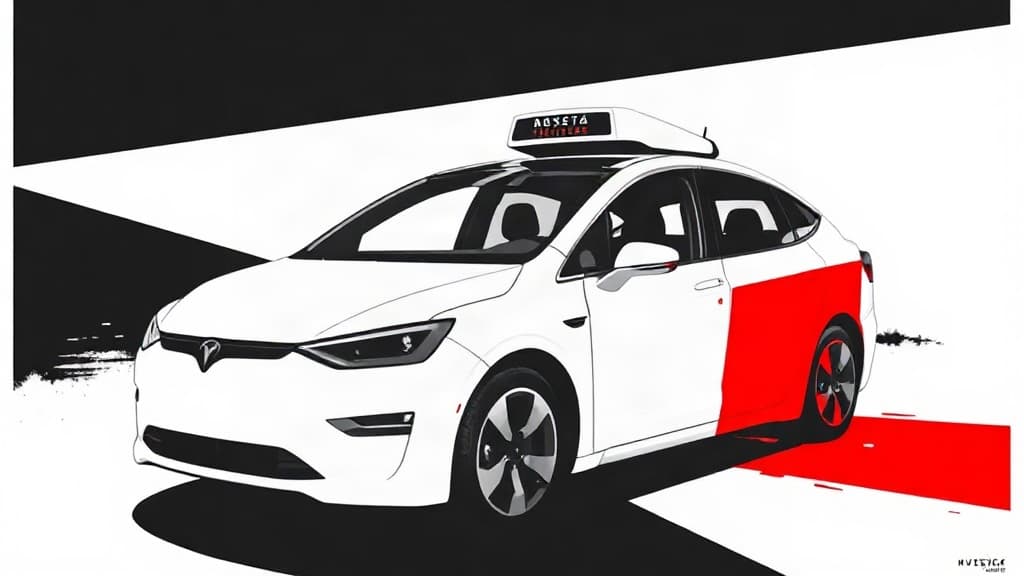
Elon Musk dropped dozens of gold-colored, self-driving Cybercabs onto the streets of Austin, Texas, on Thursday — vehicles with no steering wheels and no brake pedals — and the press wants you to call it progress. What they won't tell you is that every ride is a rolling surveillance node.
These taxis navigate using cameras alone. Tesla's system relies on a camera-only design, while rivals Waymo and Amazon's Zoox supplement cameras with radar and lidar. That means every Cybercab on the road is constantly capturing its surroundings — pedestrians, other vehicles, homes, businesses — and feeding that data back to a company that answers to shareholders, not to you. The surveillance state doesn't need a warrant when you volunteer to climb inside.
Musk needs a win. Tesla posted a second consecutive annual decline in vehicle sales, lost its crown as the world's best-selling electric vehicle maker to China's BYD, and saw profits plunge. Tesla stock rose more than 5% Thursday on Cybercab hype, but the company trails Waymo badly — Tesla has more than 200 "unsupervised" robotaxis across six cities in Texas and Florida, according to RobotaxiTracker, while Waymo has more than 4,000 in 14 cities.
Austin has had a Tesla robotaxi service since June of last year, but those cars still had steering wheels and brake pedals, and initially carried safety drivers. The new Cybercabs strip all of that away. "No steering wheel, no pedals," Tesla teased on X. Musk posted an image of a giant Cybercab floating above the Austin skyline and wrote, "A Storm of Cybercabs."
Americans aren't buying the pitch yet. A Pew Research Center survey from February found seven in 10 U.S. adults were "not too" or "not at all" comfortable riding in a driverless car. Just 7% said they would be "extremely" or "very" comfortable. Gallup polling in 2025 found skepticism about driverless car safety had risen over the previous several years, with more Americans saying all or mostly human-operated cars were the safest option compared to a 2018 poll.
All four outlets covering this launch — WTOP, WJLA, the New York Post, and the Atlanta Journal-Constitution — ran the same AP wire story. Not one mentioned data collection. Not one raised the question of who owns the footage these camera-laden vehicles record on every trip, or who can buy access to it.
Musk's long game is bigger than a few dozen cabs. He eventually hopes to send full self-driving software to hundreds of thousands of Teslas through a software update, allowing owners to turn their personal cars into taxis when not using them. Regulators in the U.S. and overseas have signaled he still has some convincing to do — Tesla has not received approval for drivers to use even its partial self-driving system without supervision in most jurisdictions.
The technology may work. The question is what else it does while it's working — and who decides what happens to the data.