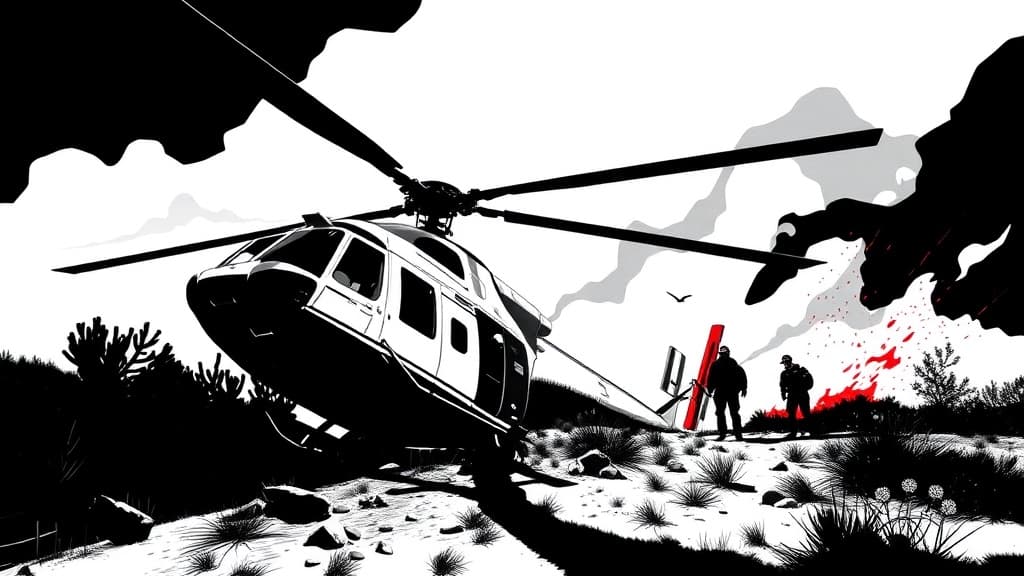
A Sikorsky S-64 helicopter went down Friday morning while fighting the Widemouth 2 Fire near Richfield, Utah, with two people aboard — and rescuers can't even reach the wreckage because the crash itself started a new fire.
That's the state of things: American firefighters dying on American soil, their equipment falling out of the sky, and nobody in Washington asking what those billions shipped overseas could have bought at home.
The Widemouth 2 Fire has burned over 105,000 acres since lightning sparked it on July 27. It is 19% contained. More than 600 personnel and seven helicopters are assigned to the blaze on the Fishlake National Forest, and now one of those helicopters is wreckage on a mountainside. Tyler Hecht, deputy incident commander with the Great Basin team, described the terrain as "very difficult" and confirmed rescuers "have not reached the scene of the accident" — partly because the crash ignited a new fire.
Firefighters took what Hecht called a "tactical pause," regrouped, and went back to work. Their morale, he said, is "very somber." The condition of the two souls aboard that aircraft remains unknown.
This is not an isolated disaster. The Guardian reports three firefighters were killed in June along the Colorado-Utah border; the New York Post puts the Colorado death toll at four, with a fifth injured after flames overran their position and they deployed emergency shelters. Either way, Americans are dying. Utah forestry director Jamie Barnes said in late June that fires are "behaving in ways veteran firefighters simply haven't seen before" and that "our resources are stretched."
Eight large fires are now burning across Utah, consuming more than 331,000 acres. Red flag warnings are in effect — erratic winds, dry fuels, hot temperatures, dry thunderstorms. The conditions are extreme and the capacity is thin.
Governor Spencer Cox called wildland firefighting "among the most dangerous jobs in the world" and asked for prayers. Prayers won't replace aging helicopter fleets or put more personnel on stretched fire lines.
The NTSB and FAA are investigating the crash. Investigators expect to reach Richfield by Saturday evening, assuming fire conditions permit safe access. They'll write a report. There will be findings — mechanical failure, pilot error, weather. What that report won't include is a line item for every dollar that left this country to fund foreign commitments while Utah's firefighters flew into smoke over American land with resources their own officials describe as stretched.
The FAA confirmed two people were on board. Their condition is unknown. The fire they were fighting is still burning. And the money that might have upgraded their equipment is somewhere overseas, doing nothing for the people of Richfield, Utah.
That's the trade-off. It's not abstract. It's sitting on a mountainside, waiting for someone to reach it.