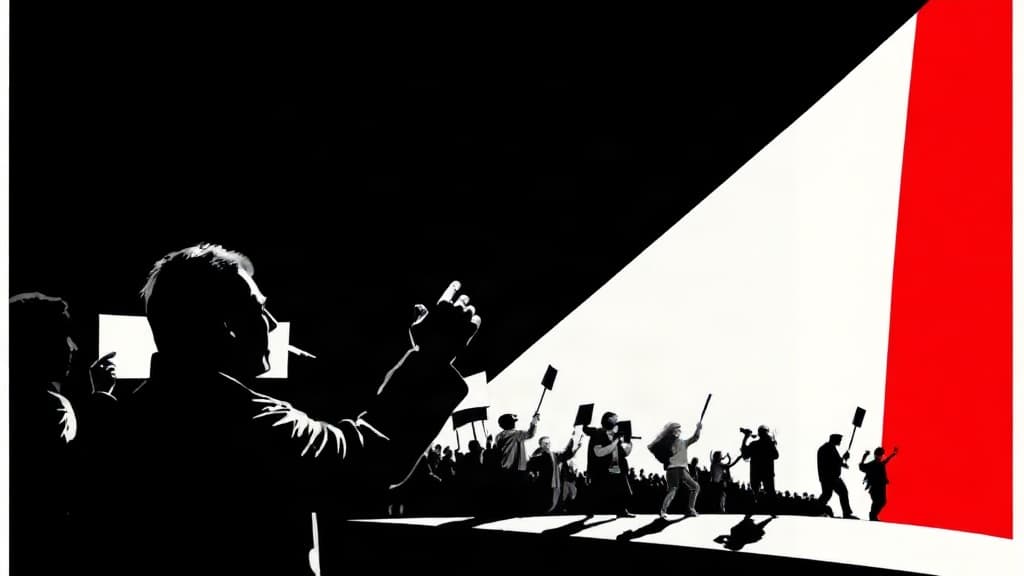
Hundreds of thousands of Czechs flooded Prague to defend mandatory license fees that force every household to subsidize public broadcasters whether they watch them or not — all while calling it freedom.
The real fight is over who controls the money pipe. Right now, Czech citizens and businesses must pay 205 koruna (about £7) a month to fund Czech TV and Czech Radio under threat of law. Prime Minister Andrej Babis, a billionaire who returned to power last year, wants to scrap those mandatory fees and fund the broadcasters from the state budget instead — with a roughly 15% cut. Protesters say that makes journalists puppets of politicians. What nobody at the rally asked is why ordinary citizens should be compelled to bankroll state media under either system.
Organizers from the group Million Moments for Democracy put the crowd at over 350,000 at Letná Plain — the same ground where Czechs rallied during the 1989 Velvet Revolution. The Guardian leaned hard into that symbolism; Newser noted it more briefly. Both outlets framed the protest entirely as a defense of democracy and media independence, with no acknowledgment that mandatory license fees are themselves a form of state coercion over citizens' wallets.
"We do witness here something extraordinary today," said lead organizer Mikuláš Minář. "It's just a beginning." Singer Šárka Dumišincová told the AP: "The media represent freedom. And the fact that someone here is trying to control that freedom is unacceptable to me." Computer programmer Jan Snasel told AFP the government was taking steps to "control" media, "cut their funding and affect what they broadcast."
Protesters carried banners reading "We won't give media away" and "We refuse the Slovak scenario" — a reference to Prime Minister Robert Fico's moves against media independence in Slovakia. Opponents liken Babis's plan to what Viktor Orbán pulled in Hungary. The Guardian gave extensive play to those comparisons; Newser mentioned them in a single sentence.
Babis pushed back. He published an op-ed calling out what he called the "seven lies" peddled by opponents and dismissed the criticism as "hysterical outbursts." "Anyone who talks about 'nationalisation' [of public media] is deliberately lying," he wrote. "Under no circumstances will we interfere." The Guardian quoted this defense; Newser didn't mention it at all.
The bill's first reading was pushed through parliament in the middle of the night in late October, according to the Guardian — a detail Newser omitted. Staff at Czech TV and Czech Radio have gone on strike. International media organizations including the European Broadcasting Union, Reporters Without Borders, and the International Press Institute have lined up against the plan.
Follow the money: under the current system, broadcasters get a guaranteed revenue stream extracted directly from citizens. Under Babis's plan, they'd have to beg the government for a smaller pot. Neither model is free. One coerces the public. The other lets politicians hold the leash. The Czechs rallying in Prague picked their side — but the real question is why those are the only two choices.