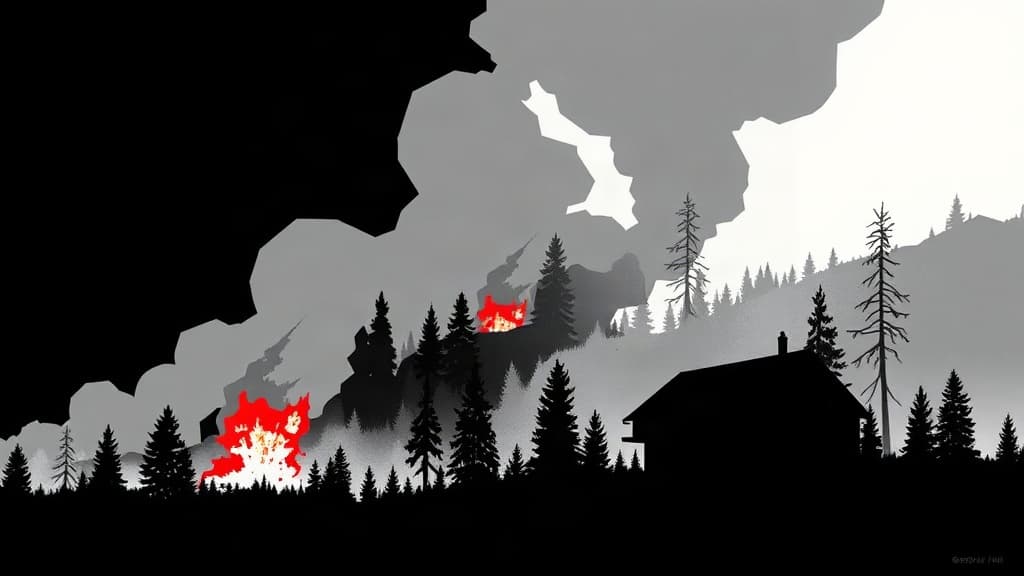
Nearly 4,000 people were evacuated from France's Atlantic coast Tuesday as wildfires that have already scorched an area four times the size of Paris threaten to explode again — and the same green orthodoxy that built the tinderbox is being offered as the only cure.
Across France and Spain, roughly 330,000 people have been forced from their homes. Spain's largest wildfire on record has consumed 50,000 hectares in Ávila. Fourteen people are dead. French President Emmanuel Macron calls it the "toughest" situation since World War II. And the establishment press, from The Guardian to CNN to AP, has one frame: climate change. What none of them mention is that decades of European environmental policy — suppressing timber harvests, blocking controlled burns, letting deadwood and underbrush accumulate in the name of "rewilding" — turned these woodlands into powder kegs waiting for a match.
Read the coverage and the pattern is unmistakable. The Guardian quotes Spanish Prime Minister Pedro Sánchez warning about "the urgency of responding to the climate emergency." AP cites the EU's Copernicus climate service noting Europe is "the world's fastest-warming continent." CNN forecasts temperatures hitting 104 degrees Fahrenheit near Bordeaux. Every outlet leads with heat. None leads with management.
But heat alone doesn't explain why these fires burn this hot, this fast, this destructively. Fuel does. And European forests are loaded with it — dense, unthinned stands and accumulated ground cover that green policy after green policy declared off-limits to the very management practices that kept fire regimes in check for generations.
AP notes, almost in passing, that "military engineers and forest-fire prevention crews resumed work early Tuesday on firebreaks" with 103 kilometers completed. That is reactive scrambling after catastrophe — not the regular, preventive clearing and controlled burning that makes firebreaks meaningful before flames arrive. A firebreak carved while the firestorm approaches is a Hail Mary, not a policy.
Firefighter Javier García, with two decades on the line, told the Associated Press: "This doesn't have a precedent." He described flames so ferocious that crews had to abandon direct attack and prioritize evacuation. That is what happens when fuel loads reach critical mass. AP itself reported the Gironde blaze "transforming at times into a self-feeding firestorm." Self-feeding — because the fuel was never reduced.
The village of Le Porge, population 3,500, lost over 180 houses — more than 20 percent of the community. CNN reported that the mayor, Martial Zaninetti, stayed behind to coordinate emergency response while the majority of residents were evacuated, unable to save their homes. These are the wages of policies that treat active forest management as an environmental sin.
Even the EU's response reveals the institutional reflex. Spokesperson Anna-Kaisa Itkonen told The Guardian that "no country can maintain alone all the resources that are needed to tackle every possible natural or other disaster." More supranational bureaucracy, more shared assets — still no mention of the policies that made the disaster inevitable.
France has burned more than 1,160 square kilometers this year, per the Interior Ministry. Ninety-three firefighters injured in Gironde alone. And the same leaders who let fuel accumulate in the name of green piety now point at the thermometer and demand more of the same doctrine.
America, take note. The same ideology is at work in our own forests — lawsuits blocking timber harvests, environmental groups opposing prescribed burns, agencies that would rather watch a million acres incinerate than let a chainsaw near a dead tree. The question isn't whether climate contributes. It's whether we manage our woodlands or sacrifice them on the altar of green dogma. Europe just gave us the answer. We don't have to accept it.