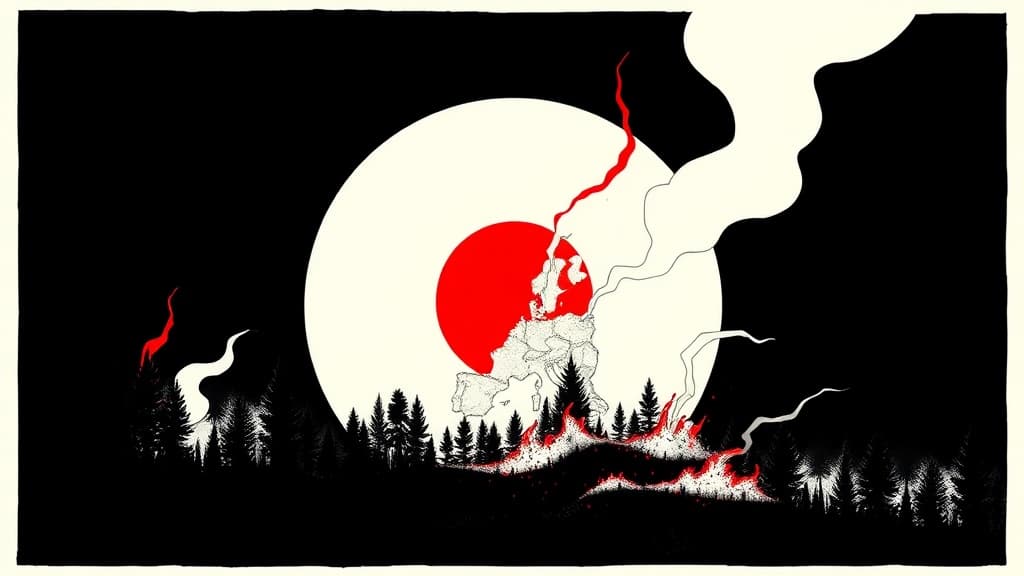
Wildfires racing across Europe are setting off buried bombs from two world wars—a literal detonation of the continent's interventionist past that killed 33,000 Americans in a single forest campaign and now threatens the crews fighting the flames.
The stakes are direct and deadly: fire responders in France, Belgium, Germany, and the Netherlands now face rusty mines and unexploded shells detonating in the heat. Europe spent the 20th century blanketing its own soil with munitions, and now that lethal inheritance is literally blowing up. For Americans, it is a visceral reminder of what interventionism costs—our boys are still buried in that soil, and the bombs that killed them haven't gone away.
Blasts have been reported across all four countries. In France, a massive wildfire outside Bordeaux uncovered a cache of WWII-era ammunition. In eastern Belgium, Gov. Hervé Jamar confirmed "a few sporadic detonations" in the High Fens region and said emergency services are adapting operations to account for buried munitions, though local media published photos of a firefighter handling a rusted bomb. In the Netherlands, a bomb-disposal team was dispatched to a forest near a site of fierce fighting in Limburg province.
The High Fens fire is smoldering atop the Battle of the Bulge battlefield—and even closer to Elsenborn Ridge and the Hurtgen Forest, where an 88-day skirmish killed roughly 33,000 American and 28,000 German troops. That is thirty-three thousand American families who got a telegram instead of a homecoming, for a war fought on another continent's soil.
Bernard Collard, a local historian who runs the Truschbaum Museum near Belgium's border with Germany, is authorized to scan the former battlefields with a metal detector. He has found mortar shells, machine guns, helmets, cigarette cases, and once, a human skeleton. "When you go into a forest like this, you are not sure where the explosives are," he said. In the first four years after Germany's 1945 surrender, leftover munitions in the province killed six civilians.
All three outlets covering the story framed the detonations through the lens of climate change. Sarah Njeri, a peace and conflict scholar at London's School of Oriental and African Studies, said "Climate change is now doing the work of unburying and reactivating what was previously stable." Euronews quoted University of Arizona researcher Christina Greene saying "the legacy of war keeps creeping up." The climate angle is real—droughts have also churned up German warships and a Wehrmacht motorbike from shrinking rivers, according to Euronews—but the legacy doing the creeping isn't the weather. It's war. The bombs were buried by governments that chose mass conflict, and they are detonating now because that choice's consequences don't expire.
Europe's political class spent the last century embroiling the continent in catastrophic wars and now spends this one demanding Americans fund their defense and follow their interventions. The unexploded ordnance is a fitting metaphor: the costs of foreign adventurism don't stay buried. They wait—sometimes for decades—and then they blow.
The question isn't whether the climate is changing. It's whether Washington will keep writing blank checks for a continent whose past wars still liter the ground with explosives, or whether it will learn the lesson those detonations are teaching.