Wildfires are tearing through Washington State and Northern California, forcing working families from their homes — and the same officials who spent decades blocking forest management are now standing at podiums calling it abnormal.
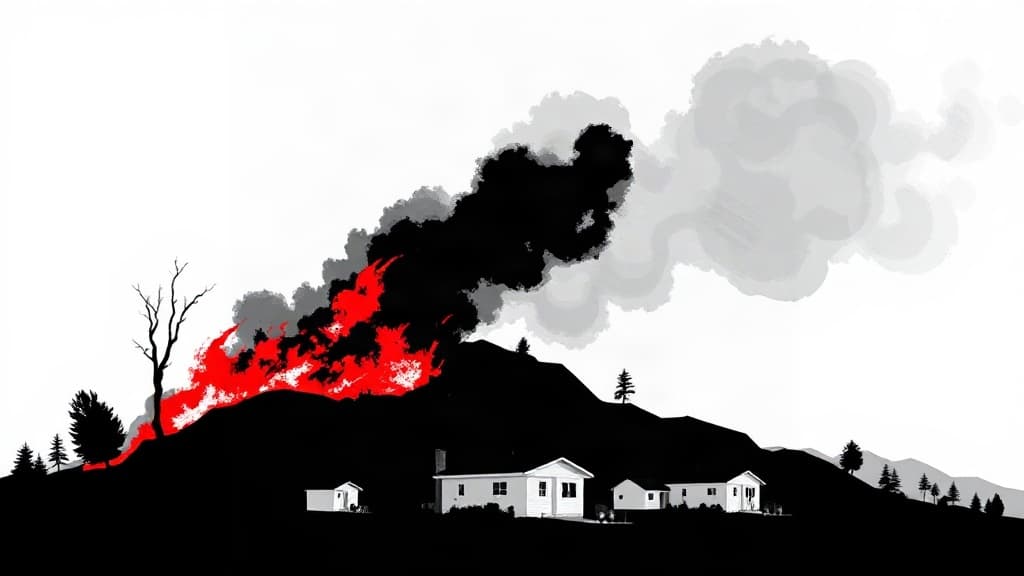
More than a dozen fires are burning across Washington, scorching roughly 250,000 acres, with large parts of Spokane County under mandatory Level 3 evacuation orders, according to the New York Times. Winds gusting up to 45 mph drove the Old Trails fire from ignition at noon to 3,500 acres by 10 p.m. In Northern California, the New York Post reports the Feliz Fire near Hopland exploded from 40 acres to over 500 in under three hours, tearing through what Cal Fire described as dry vegetation at a "dangerous rate."
Notice what fuels these fires: "dry vegetation." That is not an accident of weather. That is the predictable consequence of decades of environmentalist policy that turned working forests into overgrown fuel loads. Prescribed burns were blocked. Timber harvesting was litigated into paralysis. Dead and dying timber was left standing as kindling. The result is a landscape designed — by government policy — to burn.
Washington's commissioner of public lands, Dave Upthegrove, declared at a Saturday briefing: "This is an extraordinary fire season. This is not normal." He's right that it's not normal — but the abnormality is the mismanagement, not the climate. The New York Times framed Upthegrove's quote as straight news, offering no scrutiny of the very land-management apparatus that allowed the fuel loads to accumulate. The Post, focused on the California blaze, noted the cause remains "under investigation" — but the deeper cause, the policy failure that stacked the landscape with fuel, goes unmentioned in both outlets.
About 4,000 firefighters are now deployed across Washington, with the National Guard activated and personnel from more than a dozen states assisting, the Times reports. In California, night-flying helicopters chase the Feliz Fire after dark. This is what crisis response looks like — expensive, reactive, and dangerous. Prevention through active forest management — thinning, logging, controlled burns — was the cheaper, safer path. It was abandoned.
The people paying the price are not the policymakers or the environmental litigators sitting in air-conditioned offices. It is the families stuck in slow-moving evacuation traffic under orange skies in Spokane County. It is the residents of downtown Hopland told to be ready to leave "at any moment." It is the working-class Americans who lose homes and livelihoods while the same officials who engineered this disaster point at the sky and blame something abstract.
The fires are real. The evacuations are real. The question neither outlet asks is the one that matters: who built the tinderbox, and when will they be held accountable?