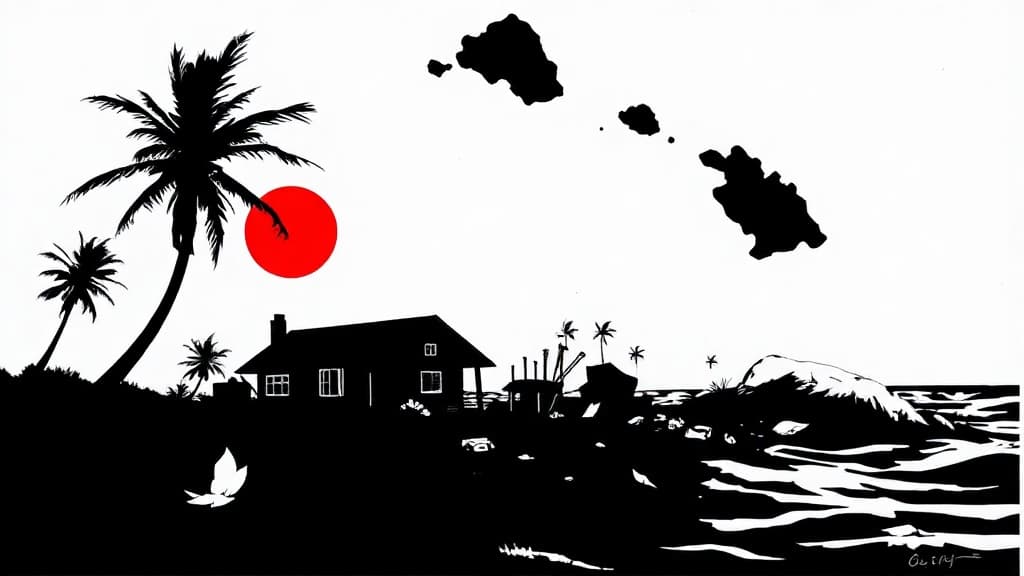
Hurricane Nolo is bearing down on Hawaii's Big Island — the third hurricane in under two months to hammer Americans still digging out from the last one, with no finished recovery in sight.
This is what it looks like when the infrastructure and leadership fail ordinary people. Communities flattened by Hurricane Lala in August haven't received basic necessities, and now they're staring down another potentially catastrophic storm. Nolo, a Category 2 hurricane with 105 mph sustained winds, is forecast to strengthen into a major hurricane this weekend, dumping up to 25 inches of rain on terrain already primed for life-threatening mudslides and flash floods.
The National Hurricane Center warns the rainfall could produce "catastrophic life-threatening flooding and mudslides, especially in areas of steep terrain." The heaviest rain is expected precisely where Lala hit hardest — where some residents remain displaced.
Mark Peters, a Naalehu resident, told NBC News the damage from the recent hurricanes is far from resolved. "We're just getting started with our recovery. But to have yet another big storm hit us, and potentially even bigger than the last one, it's difficult," he said. Peters said his community still needs basics — food and water — and that reconstruction will take years. He described driving through Waiohinu after Lala: "cars and houses moved and not where they're supposed to be, and Waiohinu Park having buildings in the baseball field."
Troy Gacayan, a high school teacher and pastor, told Honolulu Civil Beat that residents are on edge. "We're slowly starting to rebuild, but now it's almost like if this storm hits, it'll smash us back down."
Hawaii activated more than 230 National Guard members and closed schools ahead of the storm. Gov. Josh Green requested an emergency disaster declaration for four counties to access federal funds. The outlets diverge on the status: NBC News reported that President Trump approved the request Friday; The Guardian said the request "still awaits approval" as of its publication. Either way, federal assistance is for emergency protective measures — not the long-term recovery these communities still desperately need.
The framing also splits on why this is happening. NBC News noted the active Pacific season is "likely due to a record-setting El Niño — a natural climate pattern." The Guardian gave the stage to Sen. Brian Schatz, who told Congress: "There is a reason these destructive disasters are piling up one after another, leaving communities exhausted and governments depleted. It is the warming planet." Schatz urged more clean energy and pollution reduction — a pitch that reads differently when the grid in his own state can't keep the lights on through back-to-back storms.
South Point resident Tess Kala, who has family going back generations in the area, said the back-to-back storms are unprecedented: "We had a lot of family and friends that have lived here all their lives through generations and never experienced this before."
Hawaii's emergency management agency is advising residents to review emergency plans, prepare for flooding and power outages, and consider evacuating. That's cold comfort to people still waiting on the basics from the last disaster — and bracing for the next one.