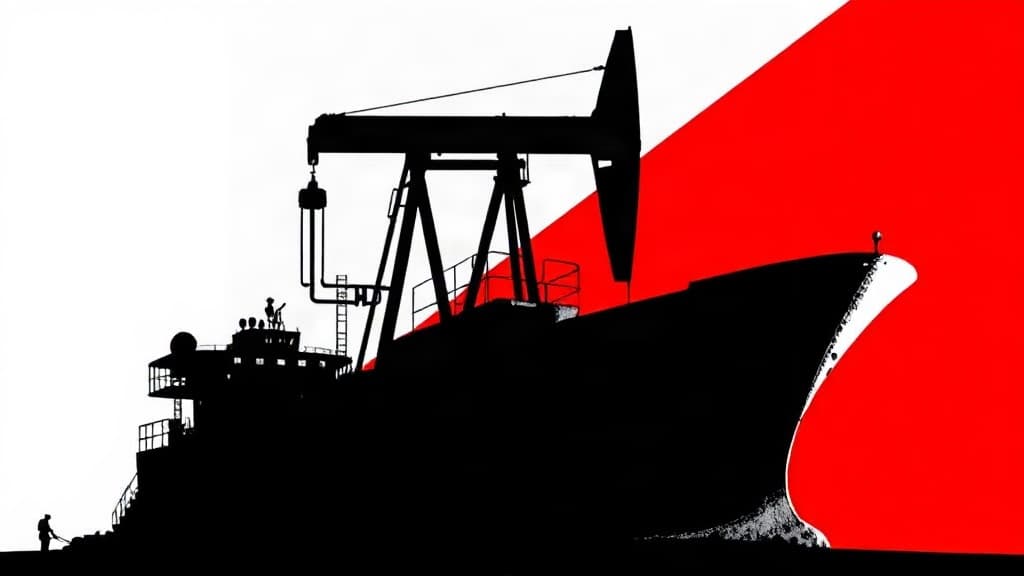
Crude oil broke $100 a barrel this week after the U.S. military destroyed five Iranian tankers in the latest escalation of a six-month war — and the bill lands directly on working Americans at the gas pump.
Brent crude, the international benchmark, surged past $100.80 on Wednesday, up more than 25% since early August, according to The Guardian. The catalyst: American forces destroyed five Iranian oil tankers linked to the Revolutionary Guard Corps after Iran twice attempted to strike a U.S. warship with ballistic missiles in the Gulf. Iran retaliated by firing 20 missiles at a U.S. base in Jordan; Jordan's air defenses intercepted 18 of them, the BBC reported. The IRGC then warned crews of oil tankers near ports in Kuwait and Bahrain to evacuate immediately or face targeting.
This is what regime-change adventurism costs. The Strait of Hormuz, through which roughly one-fifth of the world's oil flowed before this war began, is now a battleground. Iran has seized a U.S. submarine in the strait and declared new exclusion zones. The AP noted that both Washington and Tehran are fighting for control of the waterway — and every exchange of fire tightens the squeeze on global supply.
Follow the money. The Guardian reported that BP, Shell, and Centrica shares rose at least 1% on the higher oil price while the broader FTSE 100 fell. Energy majors profit; you don't. UK petrol hit 166.2p a litre and diesel 187.7p — both four-year highs. American drivers face the same pressure. U.S. benchmark crude hit $94.55, and the August inflation report due Friday is expected to show prices still running well above the Fed's 2% target, according to Europe Says.
Bank of England governor Andrew Bailey told MPs the risks on inflation "are on the upside" and pointed squarely at energy prices. Translation: central bankers will keep interest rates high — meaning borrowing costs for mortgages, car loans, and credit cards stay punishing — because a war Washington chose to start is driving up the cost of everything.
Secretary of State Marco Rubio framed it simply: "Iran continues to try to hit U.S. naval ships. And for every time they do that or try to do that, they're going to lose tankers." Tough talk. But Iran expert Danny Citrinowicz at Israel's Institute for National Security Studies warned that every strike invites retaliation and further economic damage. "There is no kinetic solution to the Strait of Hormuz problem," he said, per the AP. Every attempt at one "only brings Washington and Tehran closer to an escalation that may become increasingly difficult to control."
The AP also noted — and most outlets buried — that rising energy prices are posing political problems for Trump and Republicans ahead of November midterms. The White House is simultaneously bombing tankers and slapping new sanctions on Iran's aviation industry, doubling down on a strategy that has already failed to produce resolution after six months of fighting.
China, the world's largest crude importer, has ramped purchases back up to 9 million barrels per day from a June low of 7.15 million, according to UBS analyst Giovanni Staunovo. Beijing is buying while Washington bombs. That's the competition.
This war started with U.S.-Israeli attacks on Iran on February 28. Oil briefly hit $126 in April before falling on ceasefire hopes. Those hopes are gone. The uniparty consensus — intervene, escalate, spend — is now a line item on every American's gas receipt and grocery bill. Energy independence was working. Washington chose war instead.