Someone just sabotaged two power substations in Germany on the same day, knocking 4,200 megawatts of electricity generation offline, and nobody in Washington is asking what happens when the same hand reaches for the American grid.
This is the infrastructure vulnerability question the establishment treats as a think-tank paper topic instead of a live emergency. The U.S. power grid is sprawling, aging, and largely unguarded. If actors can short-circuit German energy infrastructure with cables and explosive devices, the same playbook works here — and our leaders aren't even having the conversation.
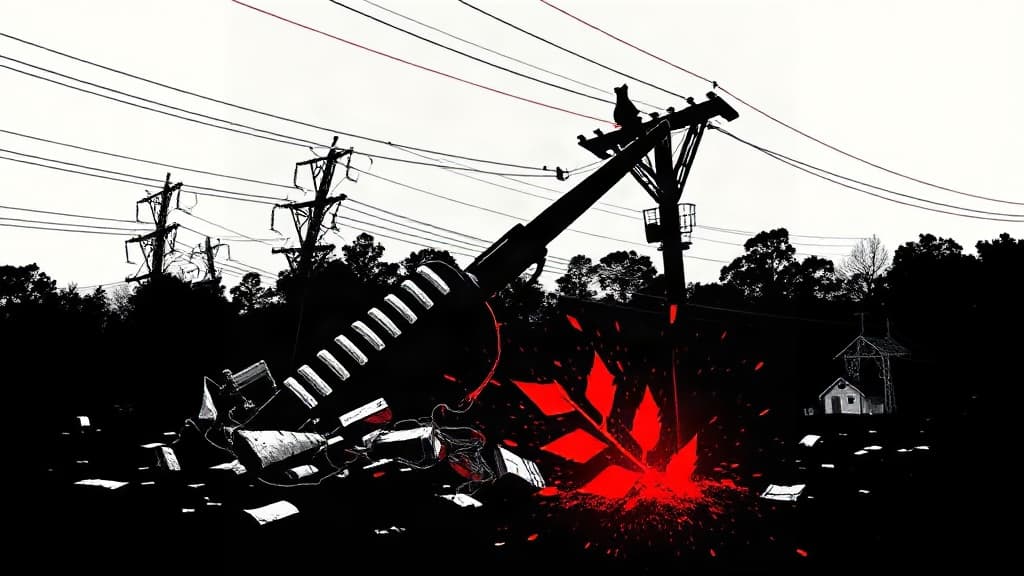
On Tuesday, multiple explosive devices were found at a substation near the Jänschwalde coal-fired power plant in Brandenburg, northeast Germany. Several of the devices caused short circuits, though no general power outage resulted, according to SFGATE.
Hours later and 300 miles away, a short circuit knocked several power lines out of service at the Bergheim substation near Cologne. RWE, the company operating coal plants that use the Bergheim substation, confirmed five coal-fired units with a combined capacity of 4,200 megawatts were taken offline. Three were expected back Wednesday; the remaining two by the weekend.
"It wasn't a broken switch, it was intentional. It was a criminal act," Herbert Reul, interior minister of North Rhine-Westphalia, told reporters. He said perpetrators "deliberately caused a short circuit by placing conductive material — presumably cables — over the overhead line." Authorities are investigating two possibilities: "sabotage directed by a foreign government and left-wing extremism. We cannot rule out either possibility at this time."
Security officials from both regions are checking for connections between the incidents. Reul wouldn't rule out links to previous attacks on German railways or what he called "hybrid threats from abroad." Brandenburg official Redmann told dpa: "This is a hybrid threat we are currently experiencing, and therefore we cannot rule out the possibility that foreign powers are behind it."
The threat is real either way. In January, suspected left-wing extremists set fire to high-voltage lines near a power plant in southwest Berlin — same infrastructure, different ideology. And Germany is already on edge after blaming Russia for a failed drone attack at Leipzig/Halle Airport on August 4. German officials cited forensic evidence and intelligence tying the operation to Moscow, according to Fox News. The Russian Embassy in Berlin called the accusation "absurd."
The hits kept coming. Wednesday morning, an explosion at Augsburg's main train station injured two Ukrainian citizens — a 17-year-old girl and an 18-year-old man — and damaged windows, the Associated Press reported. A suspicious package found nearby was determined harmless. Police said it was too early to determine a motive.
SFGATE and AP covered the substation sabotage and the Augsburg blast as separate items. Fox News led with the Augsburg explosion and the Russia angle. The New York Post buried the infrastructure story entirely, running only on the train station blast. Nobody connected the dots back to the American grid — because nobody in power is asking the question.
The U.S. has tens of thousands of substations. Most are fenced, not hardened. Responsibility is scattered across utilities, states, and federal agencies that don't coordinate. A decade of warnings from grid security assessments has produced slow, underfunded fixes.
Germany is investigating, as Reul put it, "very thoroughly." But investigating isn't preventing. The question isn't whether our grid can survive an attack. It's whether anyone in Washington cares enough to find out before someone tests it.