An Army veteran with a history of mental health encounters with federal authorities set off fireworks and poured flammable liquid outside a Lower Manhattan federal building Monday morning — and the FBI immediately rolled out its Joint Terrorism Task Force and branded him an "anti-American, anti-government extremist."
Andrew Arrabaca, 43, served in the regular Army from July 2001 to July 2004 and the New York Army National Guard from July 2004 to July 2005, according to an Army spokesperson. He held the rank of specialist and had no deployments. He left the service — and then, by all available evidence, the system left him.
Police sources told CBS News that Arrabaca had a previous encounter with federal agents, who documented him as an "emotionally disturbed person" but made no arrest. No treatment, no follow-up — just a notation. Then Monday at 8:20 a.m., he showed up at 26 Federal Plaza, a building that houses the FBI, ICE, and immigration courts, pushing a cart reading "ICE off our streets."
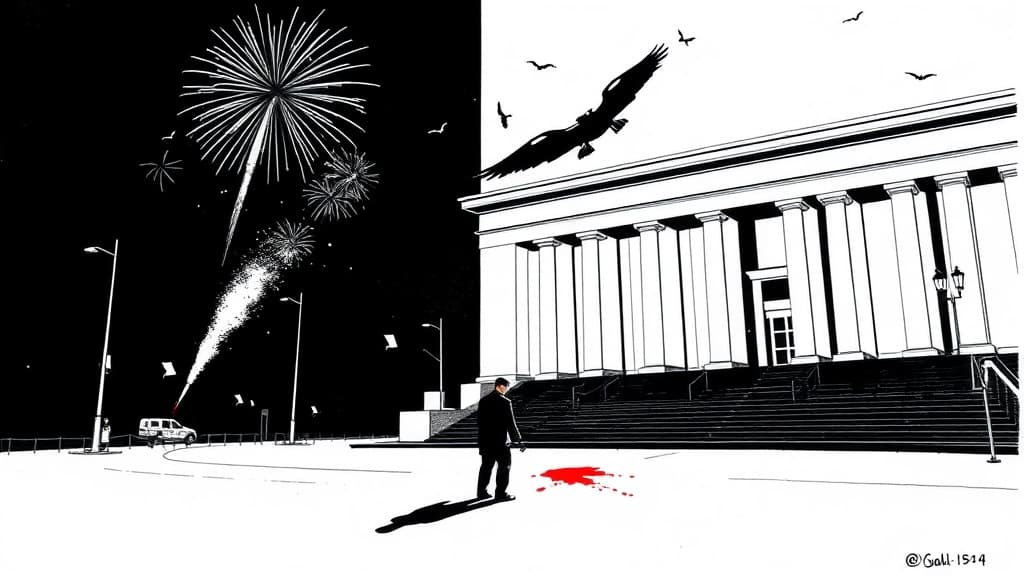
NYPD Commissioner Jessica Tisch said Arrabaca ignited a bundle of fireworks, fired several pellets from an airsoft rifle into the air, then doused the stairs in flammable liquid and set them alight. A security officer tackled him. Three people suffered minor injuries — one bystander grazed by fireworks, one officer hurt in the takedown, and one person transported to the hospital with non-life-threatening injuries, according to DHS and FDNY.
The FBI moved fast — not to ask why a veteran was in crisis, but to assign motive. Assistant Director James Barnacle called Arrabaca an "anti-ICE activist" and declared: "He is an anti-American, anti-government extremist." He "came armed with bad intentions," Barnacle said, "looking to injure people and harm people."
The weapons haul sounds menacing until you look closer. Arrabaca carried two axes, a machete, three knives, a hammer, two airsoft guns, commercial-grade fireworks, and flammable liquid. CBS law enforcement analyst Richard Esposito described the airsoft guns as "things you might use in paintball-type events." DHS said his bag also contained a manifesto, the contents of which have not been released.
ABC7 framed the incident as a "possible act of terrorism" in its lead. PBS noted what the other outlets largely buried: that 26 Federal Plaza "has become a focal point for demonstrations against the immigration policies of President Donald Trump's administration" and that the building's immigration court is where "agents have carried out chaotic and sometimes violent arrests in the hallway as migrants leave hearings." CBS was the only outlet to report Arrabaca's prior mental health encounter with federal agents.
In other words, the same government that couldn't be bothered to intervene when Arrabaca was flagged as emotionally disturbed can now mobilize the full weight of the Joint Terrorism Task Force when he acts out in front of a building where that same government conducts the kind of enforcement that drives people to protest.
New York Mayor Zohran Mamdani called the incident "deeply disturbing" and pledged to support the federal investigation.
Arrabaca served four years during the post-9/11 era and came home to no deployment, no apparent care, and a previous mental health flag that went nowhere. The FBI's answer is a terrorism probe. The question the country keeps refusing to ask is simpler: What happened to this man between the day he enlisted and the day he wheeled a cart full of fireworks toward a federal building?