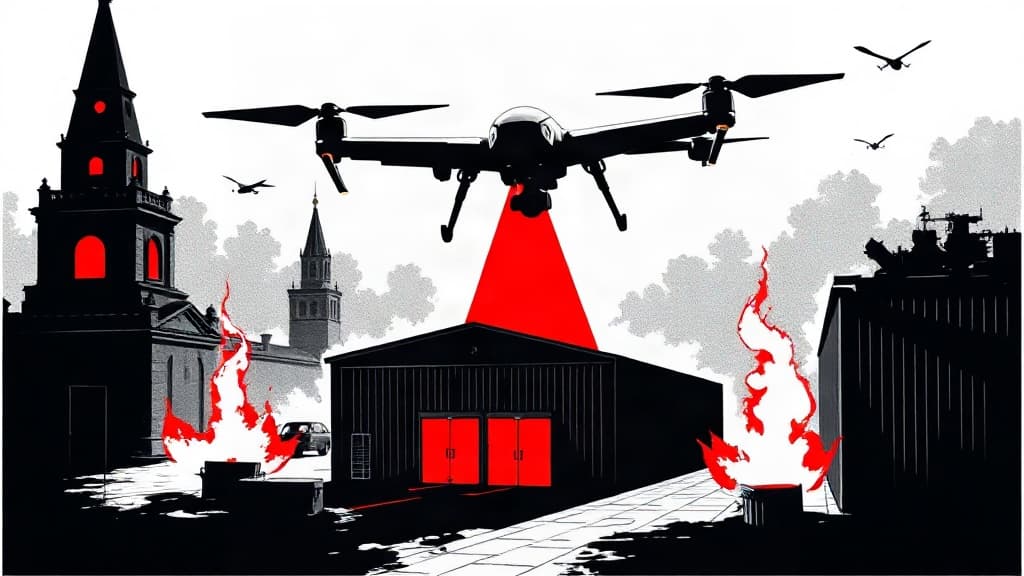
Ukraine just launched two of the largest drone attacks of the entire war against the Moscow region in three days — torching over a billion dollars in Russian infrastructure — and still nobody in Washington can explain what American interest is being served, or how this ends.
Over the weekend and into Tuesday, Kyiv sent swarms of nearly 800 drones each salvo deep into Russia, targeting the capital's air defenses and logistics networks. Russia's Defense Ministry claimed it intercepted 822 drones in the first wave and 791 in the second. Over 600 drones headed toward the Moscow region in each attack, according to Moscow Mayor Sergei Sobyanin. At least six people were killed in the first wave; the second wounded at least six and caused additional damage.
The most spectacular hit: the largest Wildberries logistics hub in the country — Russia's equivalent of Amazon — burned to the ground in Koledino. The 250,000 m² complex, one of Wildberries' two biggest warehouses, was a total loss with estimated damages exceeding $1.5 billion. A second, smaller Wildberries depot in Domodedovo was also hit. This follows the destruction of the Elektrostal hub in a July strike. Ukraine has repeatedly targeted Wildberries facilities, which it says help supply the Russian military.
Here's where the coverage splits. HotAir documented the destruction extensively with social-media footage showing the Koledino hub engulfed and then reduced to rubble. AP News, by contrast, buried the damage — reporting that Wildberries claimed its facility sustained "insignificant damage." A billion-dollar warehouse burns to the ground and the wire service runs the company's press release. AP also framed the drone campaign as a legitimate effort to "pressure Vladimir Putin into negotiating a peace settlement," quoting Ukrainian Foreign Minister Andrii Sybiha's claim that Putin refuses "realistic ceasefire proposals." Putin, of course, has shown no sign of backing down — and drone strikes on Moscow warehouses aren't changing that calculus.
Meanwhile, Russia hit back: a missile strike on a village in Ukraine's Kharkiv region killed at least 10 people and wounded eight, demolishing homes. The long-range duel escalates with neither side gaining ground on the 780-mile front, analysts say. The war is a grinding stalemate propped up by outside funding.
Which brings it back home. Every drone in those swarms, every dollar of infrastructure turned to ash on both sides, is underwritten in part by the billions Washington keeps shipping to Kyiv with no defined American interest, no cost accounting, and no exit strategy. The bipartisan establishment won't justify the spending — and won't stop it. Ukraine's drone technology may impress defense contractors and foreign governments, as AP noted, but that's an argument for the military-industrial complex, not for the American worker footing the bill.
The war escalates. The money flows. Nobody answers the question: what is this for, and when does it end?