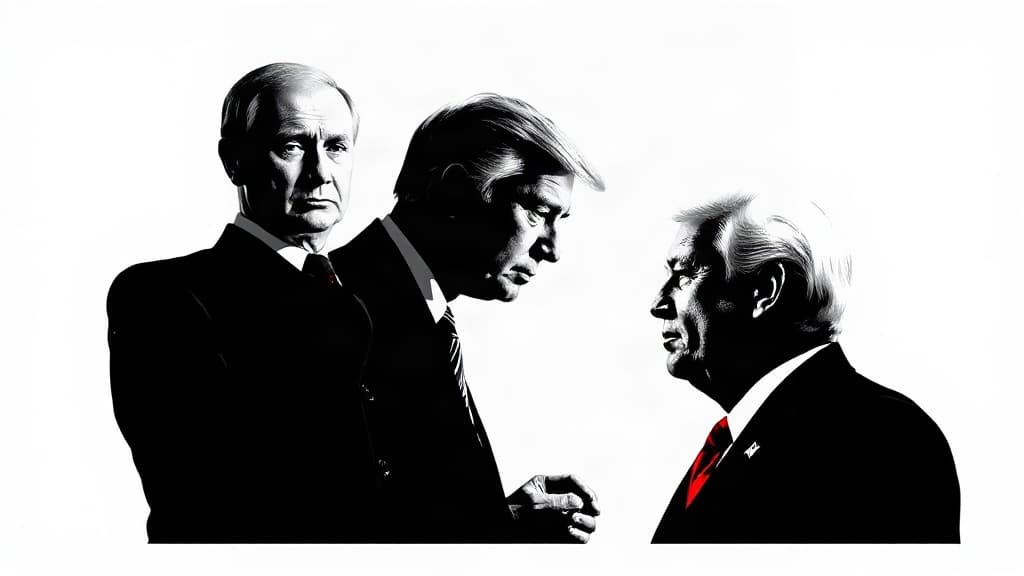
Trump signed a 14-point memorandum of understanding with Iranian President Masoud Pezeshkian at the Palace of Versailles on Wednesday, unfreezing tens of billions of dollars in Iranian assets and reopening the Strait of Hormuz — while leaving Iran's stockpile of highly enriched uranium and its ballistic missile arsenal completely unaddressed.
The deal matters because it ends a shipping crisis that stranded roughly 500 commercial vessels in the Persian Gulf for over three months and throttled global oil traffic through one of the world's most vital waterways. But the American press, by and large, isn't asking what this costs the United States. They're asking what it costs Israel.
The New Yorker framed the entire agreement as "Israel's Disaster." NBC News and the New York Times focused more on the shipping and economic ramifications — the roughly 25 vessels that began moving through the strait on Thursday, the naval mines still littering the waterway, the wavering oil prices — but the dominant frame across outlets is whether Netanyahu's political base is satisfied.
Here's what Americans should actually care about. Trump himself acknowledged the deal doesn't achieve his initial war goals, including ending Iran's ballistic missile program. "If Saudi Arabia and Qatar all have some, in relative proportion I think it's OK," Trump told reporters in France — a remark quoted approvingly by state-controlled media in Tehran. The President conceded he signed the deal to prevent "economic catastrophe" and the world "going into a depression," according to NBC News. That's an admission the war itself created the crisis the deal is now being credited with solving.
Then there's the money. The agreement unfreezes tens of billions of dollars in Iranian funds held in international banks, effectively bolstering a regime that was brought to the brink of collapse by domestic protests just months ago. Danny Citrinowicz, a former head of the Iran branch for Israel's military intelligence, warned that the deal illustrates "the failure of trying to overthrow a regime and instead only strengthening it." He's right — but the question for Americans is why we were trying to overthrow that regime in the first place, and at what cost.
The transparency problem is acute. The White House has not formally published the text of the deal. NBC News obtained it from a senior U.S. official who said its release was delayed briefly at Iran's request. A 14-point agreement that commits American resources and reshapes the balance of power in the Middle East, and the American public can't read it because Tehran asked for a delay.
Senate Minority Leader Chuck Schumer called it payoff through weakness: "Americans got almost nothing we wanted and needed, and Trump gave away the store." White House spokeswoman Olivia Wales countered that Trump achieved something "nothing short of remarkable" that will "strengthen American security for many years." Both can't be true — and neither party has a clean record on Iran. Trump and his allies ripped up Obama's 2015 nuclear agreement in part because it failed to address Iran's missile arsenal. Now Trump's deal fails to address the same arsenal, and he's defending Tehran's right to possess such weapons.
The 60-day negotiation window for a "final" deal begins in Switzerland. Iran has already claimed victory. Parliamentary Speaker Mohammad Bagher Ghalibaf said the deal showed Iran "did not allow America and Israel to achieve" their war objectives, according to the semi-official Fars news agency. Israel launched new strikes in Lebanon on Friday, and Switzerland announced the next phase of talks has been postponed. The war that was supposed to neutralize Iran has instead left Tehran richer, its missiles intact, and its hardliners — now led by Mojtaba Khamenei, regarded as even more of a hard-liner than his assassinated father — in firmer control.
The question neither party wants to answer: what was the point of this war, what did it cost Americans, and who accounts for the failure if the final deal leaves the regime in Tehran stronger than when the bombs started falling?