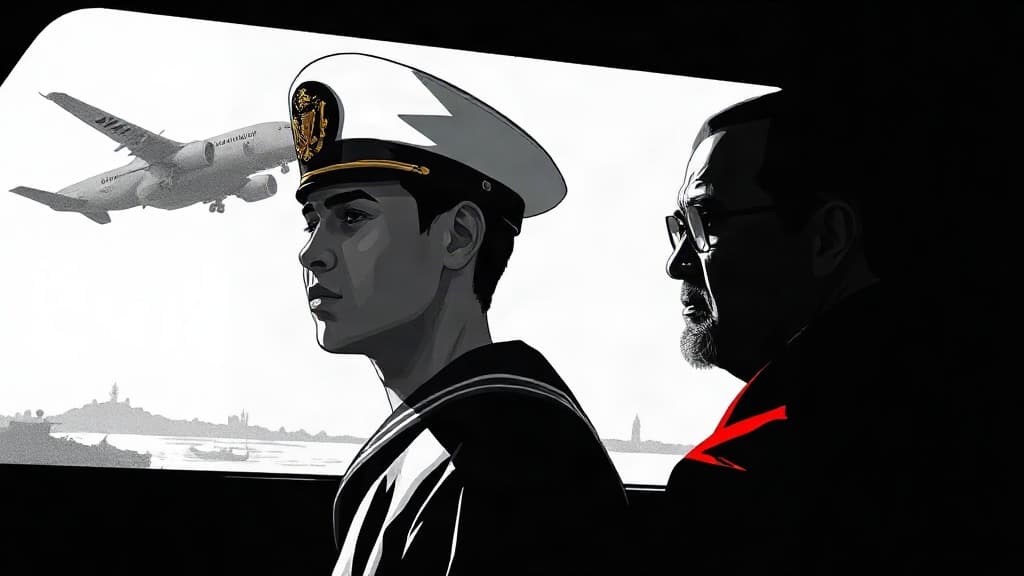
A U.S. Navy sailor on his ninth month aboard the USS Abraham Lincoln in the Middle East got a call Saturday that his father had been taken by ICE — another military family torn between a government that demands everything overseas and a bureaucracy that can't deliver basic competence at home.
Luis Manuel Aviles Roa, 48, was arrested by Border Patrol during a traffic stop in Key West, Florida, while heading to the mechanic, according to his wife, Argelia Aviles. A Nicaraguan native who has lived in the U.S. for roughly 19 years, Aviles had a work permit, driver's license, and Social Security card on him, his son said. His immigration application for legal status is pending. DHS didn't dispute that Aviles lacks a criminal record, CBS News reported.
None of that mattered. DHS confirmed he'll stay in ICE custody pending deportation proceedings. "Having a family member in the military is not a free pass to violate our nation's laws," the department said in a statement Sunday. "This Administration does not pick and choose which laws to enforce."
They have a point on the law. Aviles entered the country illegally, and DHS is enforcing statutes Congress wrote. But here's the rub: the military itself advertises immigration benefits — including "parole-in-place" — as a reason to enlist. Joshua Aviles' sister, Katherine Delgado, told the AP her brother joined the military in part because he thought it would improve his father's chances at legal status, "so that he would no longer be living in fear of being arrested." That promise turned out to be hollow.
The Trump administration rescinded prior limits on ICE and Border Patrol arrests of military family members as part of its mass deportation campaign. The AP, in the first accounting of such detentions, found that at least dozens of parents and spouses of active-duty troops have been detained — at least six deported, one self-deported. The government doesn't track these numbers officially.
Meanwhile, the USS Lincoln just set a modern record: more than 200 consecutive days at sea with no port call. Democratic lawmakers raised alarms about poor conditions and morale. The AP reported concerns about supply shortages and deteriorating mental health among the crew. Defense Secretary Pete Hegseth called conditions aboard the Lincoln "completely misrepresented."
Joshua Aviles painted a different picture: "I don't know how I can mentally continue working 12+ hour days knowing that my dad is somewhere, possibly being treated like a criminal."
His sister told CBS News he's having trouble sleeping and eating. His mind is on his father, not the mission.
The Guardian and Reuters framed this primarily as a civil rights story, citing advocacy groups concerned about racial profiling. CBS and the AP did more to surface the military-specific breakdown — the rescinded protections, the broken enlistment incentive, the Lincoln's brutal deployment. What none of the outlets pressed hard on: Congress wrote the immigration law DHS is enforcing, and Congress has failed for decades to fix it. Both parties own that failure. The sailor gets sent to the Middle East for a war with no defined exit, his ship stays at sea for 200 days, and the system his family followed for nearly two decades can't deliver an answer — only a detention cell.
The ship left the Middle East on Saturday. The father is still in custody.