An American sailor is missing after a Navy helicopter went down in the Arabian Sea early Wednesday — operating off a carrier parked within striking distance of Iran — and the only answer from the Pentagon is silence about what the mission was in the first place.
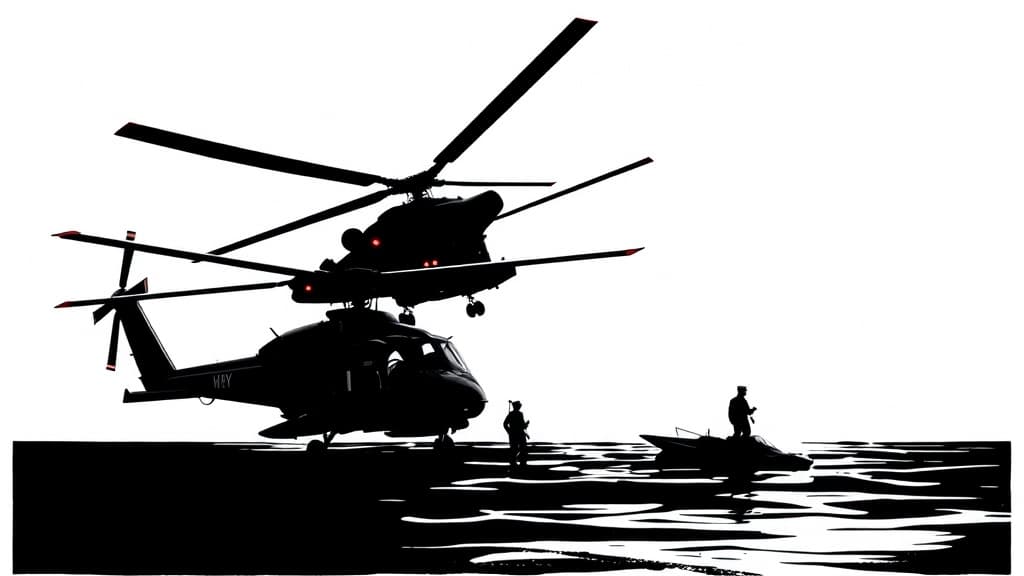
An MH-60S Seahawk assigned to the USS George H.W. Bush conducted an "emergency water landing" at 3:30 a.m. ET, according to a statement from the U.S. 5th Fleet. Three of the helicopter's four crew members were recovered and are in stable condition aboard the carrier. The fourth remains missing. The Navy says there is "no indication the emergency was caused by hostile action." The incident is under investigation.
The New York Post framed the crash as occurring "where the fleet is operating for Iran War" — a telling headline that raises the question neither outlet bothered to pursue: what is the American interest being served by parking a 5,000-person carrier group within range of a country we've already exchanged strikes with?
Because we have exchanged strikes. The Daily Caller reported that the U.S. and Iran traded blows on Saturday after President Trump claimed Iran violated a ceasefire outlined in a memorandum of understanding. CENTCOM stated that the Iranian Revolutionary Guard Corps hit two commercial vessels — the Kiku on Saturday and the Ever Lovely on Friday — using one-way attack drones. "The unwarranted aggression against commercial shipping by Iranian forces clearly violated the ceasefire," CENTCOM posted on X.
Maybe it did. But "freedom of navigation" in a waterway thousands of miles from the American coast is not a blank check for permanent military deployment, and it is certainly not a justification for sliding into another Middle Eastern war. The Seahawk that went down can be configured for anti-surface warfare, special operations, combat search and rescue, or mine countermeasures — the Navy declined to say which package this helicopter was carrying. Each of those airframes runs $25 million to $31 million. The cost of the carrier, the crew, the fuel, the ordnance — all of it competes with every dollar not spent on Americans at home.
Both outlets reported the facts of the crash. Neither asked the obvious question. CENTCOM did not respond to a request for comment, according to the Daily Caller, and the 5th Fleet declined to comment further. A sailor is missing. A helicopter is at the bottom of the Arabian Sea. And the machine that put them there — the sprawling, unquestioned forward deployment of American military power — keeps running on autopilot.
The pattern is the same one that has dragged this country into one open-ended entanglement after another: provocation, incident, escalation, and then a permanent presence with no exit strategy and no defined objective. Before this becomes the next forever war, someone in Washington ought to be forced to answer for it.