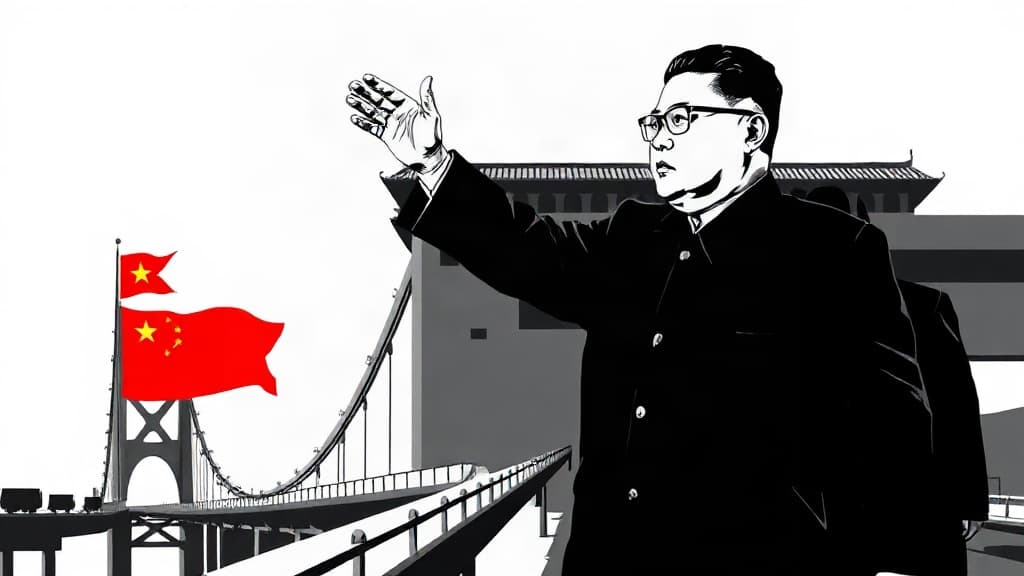
North Korean dictator Kim Jong-un crossed into China this weekend over a newly opened bridge, cementing ties between two nuclear-armed U.S. adversaries while American taxpayers keep footing the bill for a foreign policy that pushes our rivals into each other's arms.
The trip — Kim's sixth to China and his first in over a year — comes just weeks after North Korea opened a road bridge to Russia. Pyongyang is now linked by road to both its main patrons. Meanwhile, Washington has spent billions projecting power across the Pacific with no defined exit and no honest accounting of what it costs Americans at home.
Kim arrived in the Chinese border city of Dandong after crossing the New Yalu River Bridge, according to South Korea's unification ministry and China's official Xinhua news agency. The 3km bridge opened in mid-October — 12 years after China finished building it, delayed by the North Korean side. He met Wang Huning, a standing committee member of China's Communist Party, and the two toured a car factory.
Kim said his country "stands ready to work with China to carry forward their historical friendship and expand practical cooperation, thereby delivering tangible benefits to the peoples of both countries," according to Xinhua.
The visit was timed to the 25 October anniversary of China's first major victory in the Korean war — when Chinese troops crossed the Yalu River into North Korea in 1950. Japan's Kyodo news agency reported traffic controls and restricted hotel bookings around the bridge and a war museum, measures linked to the visit.
The broader picture is what matters. In early September, North Korea and Russia opened the first road bridge across their shared border. Kim last visited China in September 2025 for a military parade in Beijing alongside Xi Jinping and Vladimir Putin — all three authoritarian leaders standing together while Washington wrung its hands. Xi visited Pyongyang in June, his first trip there in seven years.
The Atlanta Journal-Constitution, citing AP, noted that South Korea's presidential office and unification ministry didn't immediately confirm the visit, and that North Korean and Chinese state media didn't immediately report it. The Guardian, by contrast, led with Xinhua's confirmation and the diplomatic choreography. The gap is telling: even among allies, nobody wants to be first to acknowledge how tightly these regimes are binding together.
Relations with South Korea are deteriorating fast. Kim's sister, Kim Yo Jong, has issued about 10 statements criticizing Seoul since late September — a frequency South Korea's unification ministry called unusual — and announced plans to resume loudspeaker broadcasts at the border within days.
Xi will host the APEC summit in Shenzhen on 18-19 November, fueling speculation about a Kim-Trump meeting. Reuters reported that U.S. and South Korean officials see little chance of that happening this year.
Here is the question the foreign policy establishment won't answer: if the strategy is to isolate North Korea, why is Pyongyang more connected to Beijing and Moscow than at any point in decades? Every dollar spent enforcing a world order that achieves the opposite of its stated goal is a dollar that isn't solving a problem at home.