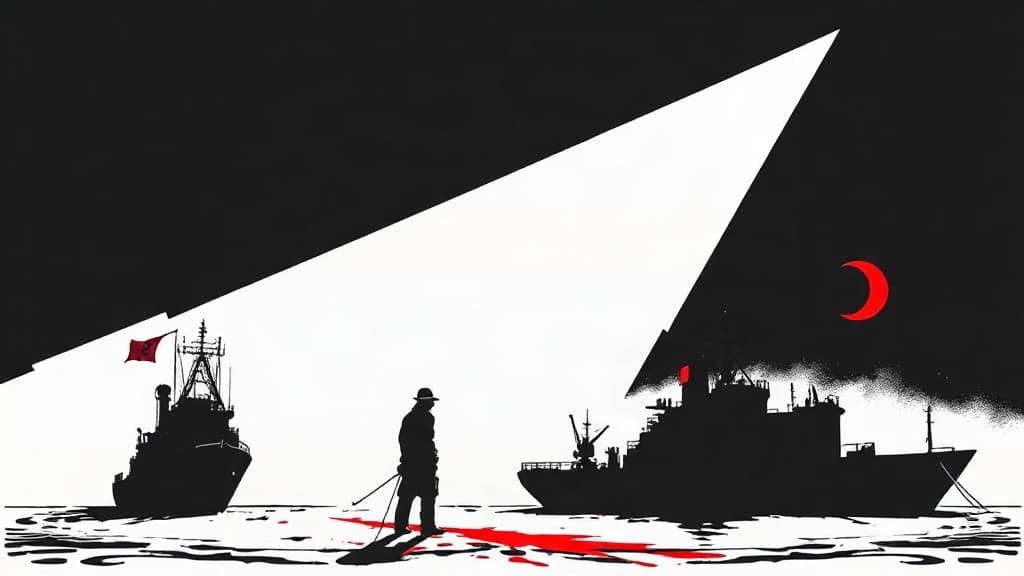
Iran's Revolutionary Guard says it struck a Togo-flagged oil tanker in the Strait of Hormuz for an "illegal attempt" to transit the waterway — and the usual crowd in Washington will use it to demand more American blood and treasure in a conflict even our allies are refusing to fight.
South Korea's president, Lee Jae Myung, said flatly on Friday that his country will not deploy military assets in support of the U.S. war on Iran. "There won't be deployment that would involve or enter war. I can tell you that very clearly," Lee said at a news conference, according to The Guardian. He is, however, reviewing whether to expand Seoul's existing anti-piracy naval presence off Somalia to protect commercial shipping and crude shipments through the region.
So let's get this straight: a key U.S. ally won't put skin in the game, but American sailors and soldiers are expected to keep policing the Persian Gulf on everyone else's behalf. The AJC reported the tanker strike matter-of-factly, burying the strategic implication — that every incident like this becomes a pretext for escalation. The Guardian, meanwhile, framed Seoul's refusal as "defying Trump pressure," making the U.S. president the story rather than the question of why American families should underwrite another Middle Eastern conflict.
Follow the money. Trump has pressured Seoul to join the Iran fight and retaliated by scaling back joint military drills this summer. But the real leverage is economic: South Korea committed last year to invest $350 billion in U.S. manufacturing in exchange for Washington lowering tariffs on Korean imports to 15 percent. Lee now says parts of that deal are "difficult for Seoul to accept" over commercial viability concerns, and a parliamentary briefing on the investment plans was just postponed. That's $350 billion in promised domestic investment hanging in the balance while Washington tries to drag an ally into a war it doesn't want — and that ordinary Americans never voted for.
Iran's claim about the tanker Trend could not be independently confirmed, the AJC noted. Whether the strike happened exactly as Tehran claims matters less than what Washington does with it. Every Gulf incident is a lobbying opportunity for the defense industry and the think-tank class that lives on foreign escalation. The permanent Washington apparatus treats every strait closing, every tanker hit, as an automatic trigger for American response — no defined U.S. interest, no cost accounting, no exit strategy.
South Korea is doing what every rational actor does: calculating its own interests. It will protect its crude shipments but won't be drawn into a shooting war. The American people should demand the same standard from their own government — a defined objective, a price tag, and a way out — before one more dollar or one more life gets committed to the Strait of Hormuz.
The question isn't whether Iran is behaving badly. It's who pays for the response, and who profits from it. The answer so far: you pay, someone else profits.